
Key points
- Preservation age is 60 for anyone born on or after 1 July 1964, so a 60-year-old who has retired can access their super.
- The ASFA comfortable standard is around $55,900 a year for a single and $78,600 for a couple (ASFA Retirement Standard, homeowners).
- Drawing 5% of a $2 million balance is $100,000.
- From 1 July 2026 the transfer balance cap is $2.1 million, so one person can move a $2 million balance into a tax-free retirement pension.
- A $2 million balance sits under the $3 million Division 296 threshold, so the extra 15% tax on large balances does not apply.
Retiring at 60 with $2 million puts you well ahead of most Australians. The comfortable retirement benchmark for a couple is around $78,600 a year, and a 5% draw on $2 million is $100,000. For the large majority of people, yes, it is enough. The harder questions sit underneath that: how many years the money has to cover, how it’s taxed once you start drawing it, and whether the way you invest protects the balance through a bad run of markets early on.
Where $2 million sits
The ASFA Retirement Standard is the usual reference point. It puts a comfortable lifestyle at roughly $52,000 a year for a single homeowner and $73,000 for a couple, covering private health cover, regular travel, a reasonable car and eating out. Those figures assume you own your home and draw your super down over time.
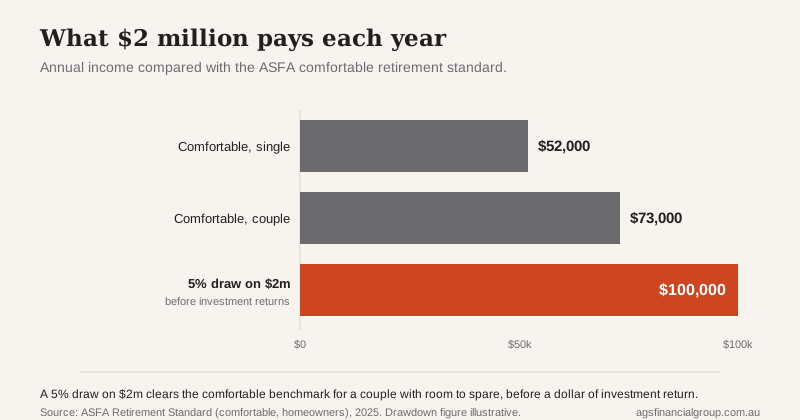
The gap between the benchmark and a $2 million balance is the point. A couple spending at the comfortable level could draw well under 4% and leave the balance to keep working. A single person with $2 million has more income than the couple benchmark. That headroom is what turns “enough to get by” into “enough to absorb surprises”: a health event, a market fall in the first few years, helping an adult child, or simply living longer than the averages suggest.
The number that matters is time
At 60, the balance may need to last more than 30 years. A man reaching 60 today can expect to live into his mid-80s on average, a woman a little longer, but averages hide the people who live well past 90. Planning to a life expectancy figure is the common mistake. Half of people outlive it.
Over 30 years, inflation does most of the damage. At 3% a year, prices roughly double over that span, so $73,000 of spending today needs to become around $146,000 by your late 80s to buy the same lifestyle. A balance that only just covers year one will fall short by year 20. This is why a $2 million starting point is comfortable rather than tight: it leaves room for the drawdown to rise with prices without draining the capital too early.
How it’s taxed once you retire
Superannuation is one of the most tax-effective structures available in retirement, and the rules improved for balances at this level.
- The retirement phase is tax-free on earnings. Once you move super into a retirement income stream, the investment earnings inside it are not taxed, and the pension payments to you are tax-free from age 60.
- The transfer balance cap rose to $2.1 million. From 1 July 2026 the transfer balance cap is $2.1 million (ATO). One person can move a $2 million balance entirely into the tax-free retirement phase and stay under the cap.
- You sit under the Division 296 threshold. The extra 15% tax on earnings applies only to the portion of a super balance above $3 million (Division 296, from 1 July 2026). A $2 million balance is clear of it.
For a couple, the position is stronger again, because each person has their own $2.1 million cap. A combined $2 million split across two members sits comfortably in the tax-free phase with room to keep contributing.
The Age Pension question
Most people retiring at 60 with $2 million will not receive the Age Pension, and not for years. Age Pension eligibility starts at 67, and the assets test cuts out around $1.05 million in assessable assets for a homeowning couple and around $697,000 for a single (Services Australia, indexed twice a year). A $2 million balance is above both.
That is not a problem to solve, it is a consequence of being self-funded. What it does change is the plan: the strategy runs entirely on your own capital for the first stretch of retirement, and the Age Pension may only come into play later, if and when the balance draws down below the thresholds. Building that possibility into the projection matters more for a couple, because the thresholds and the part-pension taper can add meaningful income in the later years.
The real risk is sequencing, not the size
The threat to a $2 million retirement is rarely running out. It’s a poor sequence of returns in the first few years combined with drawing income at the same time. A market fall of 20% in year two, while you’re withdrawing $100,000, locks in losses that a working balance would have recovered. The same average return, in a different order, produces very different outcomes when you’re drawing down rather than contributing.
The tools that manage this are well established: holding several years of spending in cash and defensive assets so you’re not selling growth assets into a fall, keeping the growth allocation working for the decades the money still has to run, and reviewing the drawdown rate rather than setting and forgetting it. A self-managed super fund gives some retirees more direct control over how that mix is held, though it brings its own responsibilities and costs. For most, a well-structured retirement income stream does the same job.
When spending runs higher
The comfortable benchmark is not everyone’s target. A couple who travel often, run two cars and want to spend $120,000 or more a year are drawing at a very different rate. At $120,000 that is a 6% draw on $2 million, above the conservative 4% to 5% range that tends to sustain a 30-year retirement. At that level the balance can deplete before the plan is done, and a weak run of markets in the early years makes it more likely. The plan does not fail, but it needs more than a single drawdown rate to stay on track. Two key options can be considered.
Innovative lifetime income streams. A lifetime income stream pays an income guaranteed by the provider for as long as you live, which takes longevity risk off part of the portfolio. Pairing one with an account-based pension covers the essential spending for life while the rest of the balance stays invested and flexible. These products also receive concessional treatment under the Age Pension means test, so they can lift entitlement in the later years once the balance has drawn down. The trade-off is access: the capital committed to a lifetime stream is less accessible, so it suits part of a portfolio rather than all of it.
Freeing up other retirement capital. For most couples the family home is the largest asset, and it sits outside super doing nothing for the retirement income plan. Downsizing in retirement releases capital that can be invested to produce income, and the downsizer contribution rules let eligible home-sale proceeds move into super on top of the normal contribution caps. For a couple spending above the benchmark, that extra capital can be the difference between drawing down too fast and drawing at a rate the balance can sustain. The timing and eligibility are worth planning as part of a retirement plan, because the rules on age, ownership period and the cap are specific.
Getting the plan right
$2 million is enough to retire at 60 for the large majority of people. Whether it stays enough depends on decisions that are easy to get wrong on your own: how the balance is invested through a 30-year retirement, how the drawdown rises with inflation, how the tax-free cap and contribution rules are used in the years before you stop, and how a couple coordinates two balances and two caps.
That is the work behind a retirement plan, and it’s what our retirement planning team does across our Sydney, Melbourne and Brisbane offices, with the accounting and the advice under one roof so the strategy and the tax treatment stay aligned. If you’re weighing up retiring at or near 60, book a free initial discussion and we’ll model your own numbers rather than a benchmark.