
— Free 30-minute discussion
Had a redundancy payout? Make the lump sum work
A genuine redundancy is partly tax free, but the harder questions come after: what to do with the balance, whether to top up super, and how to cover the gap before the next role. A free 30-minute discussion works through your numbers and the next move. No cost, no obligation.
Book a free discussionKey points
- A genuine redundancy payment is tax free up to $13,598 plus $6,801 for each completed year of service in 2026-27 (ATO).
- Only completed years count. Eleven months of service adds nothing to the limit.
- The amount above the tax-free limit is taxed as an employment termination payment at 17% at or above preservation age, or 32% below it, including the Medicare levy.
- The ETP cap for 2026-27 is $270,000. The whole-of-income cap is $180,000.
- Unused annual leave and long service leave are taxed separately and never form part of the tax-free redundancy amount.
- The super guarantee is not paid on a genuine redundancy payment or an employment termination payment, because neither is ordinary earnings for work.
Losing a role is unsettling enough without a payslip that’s hard to read. Redundancy payments are taxed under their own rules, separate from ordinary income, and the outcome varies enormously depending on length of service and age.
The headline number on the letter is rarely what lands in the account. Understanding which parts are tax free, which are concessionally taxed, and which are taxed as normal income makes the difference between planning around the payment and being surprised by it in July.
What counts as a genuine redundancy
The concessional treatment applies only to a genuine redundancy, which the ATO defines narrowly. The position itself must be abolished, and the employer must have no intention of filling it.
Resigning doesn’t qualify. Neither does dismissal for performance or conduct, the end of a fixed-term contract that simply expires, or retirement. Payment must generally be made within 12 months of termination, and there must be no arrangement to re-hire the person into the same role.
Where the payment fails the genuine redundancy test, the whole amount is treated as an employment termination payment with no tax-free component at all. The distinction is worth confirming in writing with the employer before the payment is made.
The tax-free limit
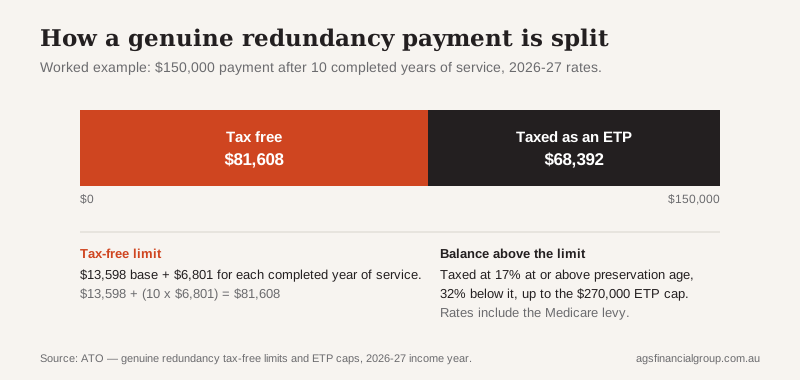
For the 2026-27 income year, the tax-free part of a genuine redundancy payment is:
$13,598, plus $6,801 for each completed year of service.
Completed is the operative word. Service of nine years and eleven months counts as nine years. That single month costs $6,801 of tax-free threshold, which is why termination dates near a service anniversary are worth checking.
| Completed years of service | Tax-free limit 2026-27 |
|---|---|
| 3 years | $34,001 |
| 5 years | $47,603 |
| 10 years | $81,608 |
| 15 years | $115,613 |
| 20 years | $149,618 |
How the balance is taxed
Anything above the tax-free limit becomes an employment termination payment. ETPs get concessional treatment up to a cap, and the rate depends on age.
- At or above preservation age (60): 17% on the amount up to the ETP cap, including the Medicare levy.
- Below preservation age: 32% on the amount up to the cap, including the Medicare levy.
- Above the cap: taxed at the top marginal rate of 45% plus the Medicare levy.
The ETP cap for 2026-27 is $270,000. A separate whole-of-income cap of $180,000 applies to some payments, and where both are relevant the lower cap applies. That second cap counts other taxable income for the year, so a large redundancy paid on top of most of a year’s salary can push more of the payment into top-rate territory than the headline cap suggests.
What isn’t part of the redundancy payment
Several amounts commonly appear on the same final payslip and are taxed under different rules.
- Unused annual leave. Taxed at a flat 32% when paid as part of a genuine redundancy, and it never counts toward the tax-free limit.
- Unused long service leave. Similar treatment, with the rate depending on when the leave accrued.
- Salary, wages and bonuses owed. Ordinary income, taxed at marginal rates.
- Payment in lieu of notice. Forms part of the ETP rather than the tax-free amount.
Lumping these together is the most common source of confusion about a final payment, because the tax-free redundancy figure applies to one component and not the rest.
Timing across two financial years
Because ETP tax depends partly on total income for the year, the income year in which the payment falls matters. A redundancy paid in June sits on top of a full year’s salary. The same payment made in July lands in a year where earnings may be much lower.
Employers rarely have flexibility on the date, and where any exists it’s worth raising early. Where the payment is fixed, the planning shifts to the deductions and contributions available in that year to manage the resulting taxable income.
Is super paid on redundancy?
Short answer: no. Your employer’s super guarantee is worked out on your ordinary earnings for work, and a genuine redundancy payment isn’t that. The tax-free redundancy amount and the employment termination payment both sit outside the super guarantee, so no 12% is added on top of the lump sum.
The same applies to the other termination amounts that aren’t ordinary earnings. Unused annual leave and unused long service leave paid out on termination don’t attract the super guarantee, and nor does the ETP. What does still carry super is your ordinary pay up to the day you finish. From 1 July 2026 that super is paid at each payday rather than quarterly, under the payday super rules.
So the figure on the redundancy letter is the figure. There’s no employer super sitting behind it, which is one more reason the payout is worth a plan. Unlike a normal pay cycle, no part of it is adding to your retirement balance the way your salary did.
The payout and your super
A redundancy payment is not automatically super, and it can’t be rolled into super the way a super benefit can. What it does create is a lump sum of after-tax money and, often, a gap in employment.
Two things follow. Concessional contributions may be available to reduce the year’s taxable income, particularly for anyone with unused carry-forward cap space from earlier years. And employer contributions stop, so anyone out of work for an extended period stops accruing super entirely, which matters more the closer the person is to retirement.
For people made redundant in their late fifties or sixties, the payment often arrives at the same moment as a decision about whether to return to work at all. That turns a tax question into a retirement planning question, and the two are best answered together rather than in sequence. For some, the payout is the point where super stops being something an employer adds to and starts being an income to draw, through an account-based pension.
Where advice earns its keep
The mechanical parts of a redundancy calculation are fixed by legislation. The tax-free limit is a formula, and the ETP rates are set. The variables sit around the edges: the timing of the payment, what to do with the lump sum, whether to contribute to super in that year, and how the gap in income affects everything else.
Our financial planning and individual tax teams work through redundancy payments together, which matters because the tax answer and the investment answer interact. Clients across all eight AGS offices in Sydney, Melbourne and Brisbane usually get more value from that conversation before the payment is made than after.
Figures in this article are the ATO limits for the 2026-27 income year and are indexed annually. Individual outcomes depend on service history, age and total income for the year.