
— Free 30-minute discussion
Should you pay down the loan or recycle it?
The right answer depends on your income, your timeframe and how you'd handle a geared portfolio through a bad year. A free 30-minute discussion works through your situation and whether debt recycling fits. No cost, no obligation.
Book a free discussionKey points
- Debt recycling and paying off the mortgage aim at the same goal, reached in parallel rather than one after the other.
- The method: use spare cashflow or existing assets to pay down a slice of the home loan, then borrow that amount back to invest. Because the new borrowing is for investment, its interest is generally tax deductible.
- Repeated over years, this converts non-deductible home-loan debt into tax-deductible investment debt while an investment portfolio builds at the same time.
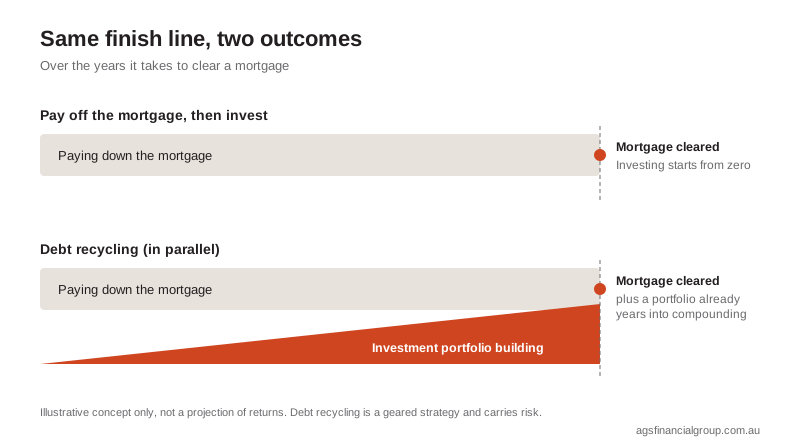
- By the date a standard mortgage would have been cleared, the debt-recycling path aims to have the loan cleared too, plus a portfolio that has been compounding for years.
- It is a geared strategy. It suits stable surplus income and a long horizon, and carries market and interest-rate risk that paying the mortgage down does not.
Most people treat wealth building as the step that comes after the mortgage is gone. Earn, pay down the loan, and once the house is finally yours, start investing. It works, but it puts investing last, and the years spent clearing the loan are years the money isn’t in the market.
Debt recycling changes the order. Instead of waiting for the mortgage to disappear before investing, it starts building an investment portfolio now, funded by borrowing, while the home loan is still being paid down. The destination is the same. The two jobs just run at once instead of one after the other.
Series versus parallel
Paying the mortgage off first is a sequence. Every spare dollar goes at the loan, and investing waits its turn. The appeal is obvious. It’s simple, it’s safe, and watching the balance come down feels good.
The cost is time out of the market. If it takes twenty years to clear the loan, that’s twenty years before the first invested dollar starts compounding. Building wealth is largely a matter of putting money to work in markets and leaving it there, so a late start is a real cost even when nothing goes wrong.
Debt recycling runs the two jobs together. The mortgage still gets paid down, and a portfolio grows at the same time. The finish line is the same date the mortgage would otherwise have cleared. What differs is what’s standing next to it on that date. In fact, the portfolio helps pay the home off sooner!
How the mechanics work
Take some surplus cashflow, or free up some existing assets, and use it to get a little ahead on the mortgage. Then borrow that same amount back through a separate loan split and invest it. Because the new borrowing produces investment income, its interest is generally tax deductible, unlike the interest on the home loan.
Repeat the cycle year after year and the shape of the debt changes. Non-deductible home-loan debt shrinks, and deductible investment debt grows in its place. The total owed can stay similar for a while, but more of it is now working in the market and earning a tax deduction. Our debt recycling guide walks through the mechanics step by step.
Where the gain comes from
Two ideas sit underneath the strategy. The first is that it takes money to make money, which is the case for putting some of the bank’s funds to work rather than only your own. The second is that, over a long enough period, money invested in a diversified portfolio has historically grown faster than the interest on the loan funding it.
When that holds, the maths works from two directions at once. The investment returns add to your wealth, and the deductible interest reduces your tax. Neither is guaranteed, and the gap between returns and borrowing costs is what carries the whole strategy, so the horizon has to be long enough to ride out the years when markets fall.
The same timeline, two outcomes
Picture the day the mortgage would have been paid off under the pay-it-down-first plan. On that day, the sequence approach leaves a cleared loan and nothing invested. Investing begins from zero, from there.
The debt-recycling path, run over the same years, aims to reach that same day with the mortgage also cleared and with a portfolio that has been compounding the whole time. That portfolio is the point. It’s the wealth the sequence approach was always going to build eventually, brought forward by years.
When paying down the mortgage wins
Debt recycling is a geared strategy, and gearing cuts both ways. Borrowing to invest magnifies the outcome in both directions. In a long market downturn the portfolio can fall while the investment loan stays the same size, and if interest rates climb, the holding cost rises with them. Paying the mortgage down instead is a guaranteed, risk-free saving equal to the loan rate, with none of that exposure.
So the strategy fits a particular situation: stable surplus income, a secure job or business, a long time horizon, and the temperament to leave a portfolio alone through a bad year. For someone near retirement, with uncertain income, or who would lose sleep watching a geared portfolio fall, paying the loan down is often the better call. The right answer depends on the person, not the strategy.
Getting the structure right
Most of the benefit, and most of the risk, lives in the structure. The investment borrowing has to stay cleanly separate from the home loan, usually through distinct loan splits, because the deductibility rests on what the borrowed money is used for, not which property secures it. Mix the two and the deductions can be lost.
That’s why debt recycling works best when the loan structure, the investment selection and the tax treatment are set up together. Our financial planning and mortgage broking teams run it as one piece, and there’s more on the different ways to build it in our note on variations of debt recycling.
Debt recycling asks for discipline and a long horizon, and it isn’t right for every homeowner. For someone with stable income and time on their side, it turns years that would only have cleared a mortgage into years that also build an investment portfolio worth keeping. If you want to know whether it fits your position, our debt recycling team can work through the numbers with you.