
— Free 30-minute discussion
Thinking about a transition to retirement pension?
Whether a TTR pension adds up depends on your age, balance, tax rate and how long you plan to keep working. Book a free initial discussion and we'll understand your position and how AGS can help you plan the move into retirement.
Book a free initial discussionKey points
- A transition to retirement (TTR) pension is available once you reach preservation age (60 if you were born on or after 1 July 1964) and while you are still working.
- Annual payments must be at least 4% of the account balance (under 65) and no more than 10%.
- The annual amount, anywhere from the minimum to the maximum, can be taken as a single payment or spread across regular instalments.
- Payments are tax-free. Earnings inside a TTR account are taxed at up to 15%, as the pension-phase exemption only starts once you retire or turn 65.
- You can still contribute: the concessional cap is $32,500 and the non-concessional cap is $130,000 for 2026-27.
- Once a TTR pension moves into retirement phase, the balance counts towards the $2.1 million general transfer balance cap.
A transition to retirement pension is an income stream from your super that you can start while you’re still working. It suits people in their early 60s who want to cut their hours, or who want to keep earning full pay while redirecting part of it into super. The rules sit in two places: how much you must and may draw, and how the money is taxed. Both changed shape in 2017, and the strategy looks different from how it was usually described a decade ago.
How a TTR pension works
Your super is preserved until you meet a condition of release. A TTR pension is a limited exception: once you reach preservation age, your fund can start an account-based pension from your preserved super even though you haven’t retired. You keep working, and you draw an income from the pension alongside your pay.
Three features define it:
- Income stream only. Everything you draw is a pension payment, not a lump sum withdrawal. The exception is any unrestricted non-preserved money in the account.
- A payment range. Each year you must draw at least the minimum and no more than the maximum. Any amount in that range can be paid as one payment or in instalments, as your fund allows.
- A one-way switch. Once you retire after preservation age, or turn 65, the cashing restrictions fall away and the pension becomes an ordinary account-based pension.
Preservation age is 60 for anyone born on or after 1 July 1964, so every worker now reaching their sixties meets it at the same age. Our guide to accessing your super covers every condition of release.
Minimum and maximum payments
Every account-based pension has a minimum annual payment, a percentage of the balance set by your age. A TTR pension adds a ceiling of 10%.
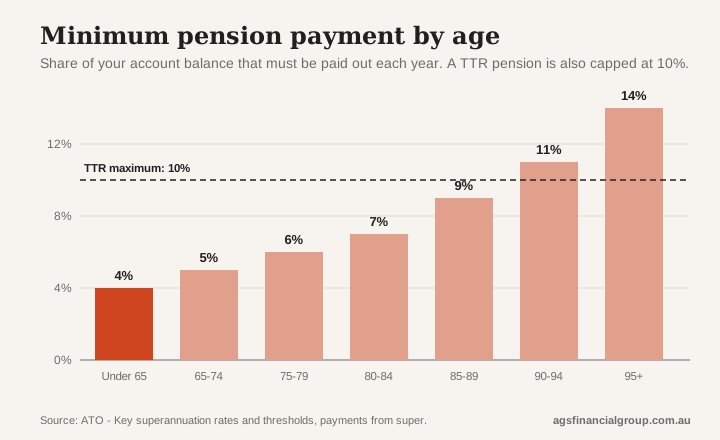
| Age | Minimum annual payment |
|---|---|
| Under 65 | 4% |
| 65 to 74 | 5% |
| 75 to 79 | 6% |
| 80 to 84 | 7% |
| 85 to 89 | 9% |
| 90 to 94 | 11% |
| 95 and over | 14% |
The percentages apply to the account balance at 1 July, or at the start date if the pension begins part-way through the year. The ATO publishes the table among its key super rates.
As an illustration only, take a 62-year-old with $500,000 in their TTR account on 1 July. The minimum payment is $20,000 (4%) and the maximum is $50,000 (10%). Any total between those figures works, and it can be taken as a single payment of, say, $30,000 once a year or as monthly instalments. A total below $20,000 can cause the fund to lose the pension’s tax treatment for the year, and a total above $50,000 breaches the TTR cap.
The 10% cap applies to the TTR pension itself. It lifts as soon as you retire after preservation age or turn 65 and tell your fund.
How TTR is taxed
Tax treatment differs for payments and for earnings.
Payments. Pension payments from a taxed super fund are tax-free once you’re 60 or over, and don’t need to be declared. The ATO’s guidance on retirement withdrawals sets out the detail.
Earnings. Since 1 July 2017, earnings in a TTR account are taxed at up to 15%, the same as in an accumulation account. The 0% earnings rate only applies in retirement phase, which starts when you retire or turn 65.
Transfer balance cap. A TTR pension doesn’t count towards your transfer balance cap while it is in TTR phase. When it moves to retirement phase the balance counts against the general cap, which is $2.1 million from 1 July 2026.
The salary sacrifice strategy
The classic TTR strategy pairs the pension with salary sacrifice. You sacrifice part of your pay into super, where it is taxed at 15% (or 30% if your income is above the Division 293 threshold), and you replace the lost take-home pay with tax-free TTR payments.
The mechanism works when your marginal tax rate sits well above 15%. Contributions are capped, though. Employer super guarantee contributions and salary sacrifice both count towards the $32,500 concessional cap for 2026-27, and a higher SG base from 1 July 2026 under payday super leaves less room. If you have unused cap from earlier years and a total super balance under $500,000, you can carry forward the unused amounts for up to five years.
Since the 2017 change to earnings tax, the gain comes from the contribution tax rate alone, not from a tax-free earnings account. For a person on a modest marginal rate, or someone paying a fund’s higher fees on a pension account, the numbers can come out flat.
Risks and trade-offs
A TTR pension pulls money out of super sooner. The costs are worth setting against any tax gain:
- A smaller retirement balance. Every dollar drawn stops compounding. A 10% draw while the fund earns less than 10% shrinks the account.
- Cap breaches. Salary sacrifice combined with employer SG and any catch-up contributions can exceed the concessional cap, and excess amounts are taxed at marginal rates.
- Fees and complexity. Running a pension account alongside an accumulation account can add cost, and an SMSF pension must meet the pension standards each year.
- Centrelink. TTR balances are assessed under the Age Pension assets and income tests once you reach Age Pension age.
- Sequence risk. Drawing from a portfolio during a market fall locks in the loss.
- Insurance and benefits. Some funds adjust insurance cover when a member starts a pension.
Who a TTR pension suits
TTR pensions tend to suit people in their early 60s, still earning, with a marginal tax rate of 30% or more and room under the concessional cap. They can also suit someone cutting back to a four-day week who wants income to fill the gap without waiting to retire.
They tend to suit people less when the super balance is small, when the person already uses their full concessional cap through SG, or when they intend to retire within a year or two. In that last case, waiting until a condition of release is met often does the same job with less paperwork.
Whether a TTR pension works for you depends on your age, balance, income and plans. It’s one of the questions we work through in retirement planning, alongside how much you need and how long it must last. Our superannuation advisers model the numbers before any money moves, and members of a self-managed super fund have the added pension-standards checks to cover. Our North Sydney retirement planning team meets clients in person or by video.
Frequently asked questions
What is a transition to retirement pension? A transition to retirement (TTR) pension is an income stream paid from your super once you reach preservation age (60 for anyone born on or after 1 July 1964) while you are still working. It was designed to let people ease into retirement by drawing some super income while working fewer hours or topping up their super.
What is the maximum you can withdraw from a TTR pension? A TTR pension is capped at 10% of the account balance each financial year. The cap lifts once you retire after reaching preservation age or turn 65, at which point it becomes an ordinary account-based pension with no maximum.
What is the minimum payment from a TTR pension? The minimum is a percentage of your account balance set by age: 4% if you are under 65, 5% at 65 to 74, 6% at 75 to 79, 7% at 80 to 84, 9% at 85 to 89, 11% at 90 to 94 and 14% at 95 and over.
Is a TTR pension tax-free? Payments are tax-free once you’re 60 or over, which every TTR member is. Earnings inside a TTR account are taxed at up to 15%, because the earnings tax exemption only applies once you retire or turn 65.
Can I take my TTR pension as a single payment? Yes. Anywhere between the minimum and the 10% maximum, the annual amount can be paid as one pension payment or in regular instalments such as monthly or quarterly, depending on what your fund offers. The total for the year still has to fall between the two limits.
Can I take a lump sum from a TTR pension? Generally no. A single payment within the minimum and maximum is still a pension payment. A lump sum withdrawal beyond that is only available for unrestricted non-preserved amounts, or once you meet a condition of release such as retiring after 60 or turning 65.
Can I still make super contributions while on a TTR pension? Yes. You can keep making concessional contributions, such as salary sacrifice, up to the $32,500 cap for 2026-27, and non-concessional contributions up to the $130,000 cap, subject to your total super balance.
Does a TTR pension affect the Age Pension? Money in a TTR pension is counted under the Age Pension assets and income tests once you reach Age Pension age, so drawing a TTR income stream doesn’t remove the balance from the tests.
If you’re approaching 60 and weighing up a TTR pension, salary sacrifice or retirement date, contact the AGS Financial Group team. Our financial planners and accountants coordinate the super, tax and cashflow sides together.