
Key points
- Preservation age is 60 for anyone born on or after 1 July 1964 (ATO).
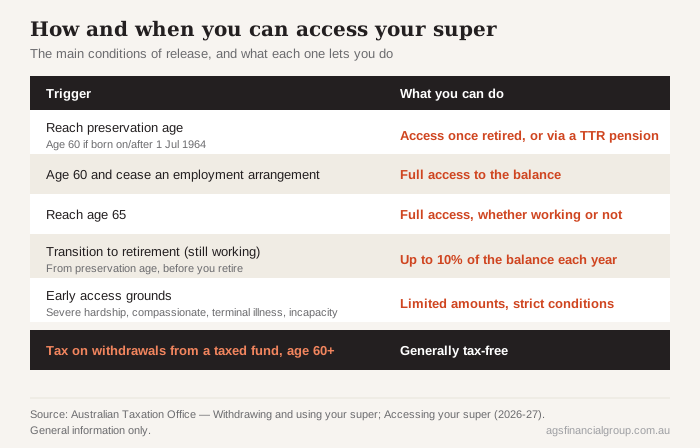
- You can access super once you meet a condition of release: reaching preservation age and retiring, turning 60 and ceasing an employment arrangement, turning 65 regardless of work, or a limited early-access ground.
- From age 60, withdrawals from a taxed fund are generally tax-free (ATO).
- A transition-to-retirement pension lets you draw super from preservation age while still working, capped at 10% of the balance a year.
- At access you can take a lump sum, a retirement income stream, an annuity, or a mix. The choice affects tax, Age Pension entitlements and how long the money lasts.
Super is designed to stay locked away until you retire, so the rules on getting to it are strict by design. Knowing which door opens, and when, is the difference between a smooth retirement income and a costly misstep. This guide covers the conditions of release, the tax that applies by age, and the choices you face once the money is available.
None of it is personal advice. The rules below are general, and your own timing depends on your work situation, your balance and your other income.
When you can access your super
Two things have to line up before you can touch your super: you have to reach your preservation age, and you have to meet a condition of release. Preservation age is now 60 for everyone born on or after 1 July 1964. If you were born earlier, you have already passed it.
Reaching that age on its own isn’t enough. You also need a trigger that tells the fund you’ve genuinely stepped back from work, or that you’ve hit an age where the question no longer matters.
Conditions of release
A condition of release is the event that releases your balance. The common ones are straightforward.
- Retiring after preservation age. You reach 60 and have no intention of returning to full-time or part-time work. This gives you full access.
- Ceasing employment at 60 or older. If you finish up with an employer at or after 60, that ending is itself a condition of release, even if you later take another role.
- Turning 65. At 65 your super is available whether you’re working or not. No retirement declaration is needed.
- Early access grounds. In limited cases, super can be released before preservation age for severe financial hardship, on compassionate grounds, for a terminal medical condition, or for permanent incapacity. The bar is high and the amounts are capped.
For most people the first three are the routes that matter. The Australian Taxation Office sets out the full list of conditions of release and the evidence each one needs.
Transition to retirement
You don’t have to stop working to start drawing on super. From preservation age you can move part of your balance into a transition-to-retirement (TTR) pension while you keep your job. A TTR pension pays you an income each year, capped at 10% of the account balance, and you can’t take it as a lump sum until you meet a full condition of release.
TTR suits two situations in particular. Some people use it to cut back to four days a week and top up the lost income from super. Others keep working full-time, salary sacrifice more into super, and replace that salary with the TTR pension to manage tax. Both need modelling before you commit, because the numbers only work in certain balance and income bands. Our financial planning team runs those projections before anyone changes their pay arrangements.
Lump sum or income stream
Once you have full access, you choose how the money comes out.
| Option | How it works | Suits |
|---|---|---|
| Lump sum | Withdraw part or all of the balance as cash | Clearing debt, a large one-off purchase |
| Retirement income stream / pension account | Convert the balance to a regular income while it stays invested | Ongoing income, tax-free earnings after 60 |
| Annuity | Buy a guaranteed income from a life insurer, for a fixed term or for life | Certainty and protection against outliving your money |
| A mix | Combine any of the above | Flexibility with a secure income floor |
A retirement income stream, also called a pension account or account-based pension, is the usual choice for retirement income. The balance stays invested, earnings inside the pension are tax-free once you’re retired, and you draw a minimum percentage each year set by your age.
There are other ways to turn super into income. An annuity buys a guaranteed payment from a life insurer, either for a set number of years or for the rest of your life, trading flexibility for certainty. Lifetime income streams, a newer class of retirement product, pay an income for life and get concessional treatment under the Age Pension means test. Many retirees combine a pension account for flexibility with an annuity or lifetime stream as a guaranteed base.
A lump sum has its place for clearing a mortgage or funding a specific cost. Taking the whole balance as cash rarely makes sense, because you lose the tax-free earnings environment that super provides.
Tax on withdrawals
Age is what drives the tax outcome. From 60, withdrawals from a taxed super fund are generally tax-free, whether you take a lump sum or a pension. That covers most private-sector super.
Before 60, if you can access super at all, tax applies to the taxable component and the rules get more involved. Untaxed funds, mainly older public-sector schemes, are taxed differently again. If your super sits in one of those, check the specific treatment before you withdraw anything.
Where this fits your retirement
Access rules are the mechanics. The bigger question is what to do with the money once it’s available, and that’s a retirement planning decision rather than a compliance one. Drawing too much early can shorten how long the balance lasts. Leaving it untouched when you could be running a tax-free pension can cost you more than it saves.
If you’re weighing up when to start, it helps to read alongside our guides on what to do with your super in retirement and how much you actually need to retire. If you run your own fund, the access rules are the same, though the paperwork sits with you as trustee. Our SMSF team handles that side for fund members.
Frequently asked questions
What is my preservation age for super? For anyone born on or after 1 July 1964, preservation age is 60. It was phased up over several years, and 60 is now the figure that applies to everyone still working toward retirement.
Can I access my super at 60 and keep working? Yes. From preservation age you can start a transition-to-retirement pension while still working, which lets you draw up to 10% of the balance each year. Full access comes once you retire, cease an employment arrangement at 60 or later, or reach 65.
Is super tax-free after 60? Withdrawals from a taxed super fund are generally tax-free once you turn 60, whether you take a lump sum or an income stream. Different rules apply to untaxed funds, mostly older public-sector schemes.