
Key points
- An account-based pension is a retirement income stream you draw from your super, usually once you’ve retired or reached preservation age (60 for anyone born on or after 1 July 1964).
- Earnings inside a retirement-phase account-based pension are tax-free, and the income payments are tax-free once you’re 60.
- You must withdraw a minimum each year, set as a percentage of the balance that rises with age: 4% under 65, up to 14% at 95 and over (ATO).
- The transfer balance cap limits how much super you can move into retirement-phase pensions. It rose to $2.1 million on 1 July 2026.
- The balance isn’t guaranteed. It runs down as you draw on it and moves with investment markets, so how you invest and how much you draw both matter.
An account-based pension is the most common way Australians turn a lifetime of super into a regular income in retirement. Your super balance stays invested, and you draw a pension from it, usually monthly or fortnightly, while whatever remains keeps earning. It replaces the pay cheque, with one important difference: the money is finite, and your choices decide how long it lasts.
Most people reach retirement with their super in an accumulation account, the one their employer has paid into for decades. An account-based pension is what you start when you stop working. You move some or all of that accumulation balance into a pension account, and from that point it’s taxed differently and it pays you an income.
What an account-based pension is
It’s a retirement income stream bought with your superannuation. You can start one once you’ve met a condition of release, which for most people means retiring after reaching preservation age, or simply turning 65. You choose how often the income is paid and, above the legislated minimum, how much.
The account stays invested in your chosen options, from conservative cash and fixed interest through to growth assets. The balance rises and falls with those investments and falls as you draw on it. When it reaches zero, the pension stops. There’s no guarantee attached, which is the trade-off for the flexibility and the growth potential.
Industry and retail super funds offer account-based pensions, and so does a self-managed super fund. The mechanics are the same across all three; the difference is how much control and responsibility you take on for the investments.
How it differs from accumulation
In accumulation phase, earnings inside your super are taxed at up to 15%. Move the balance into a retirement-phase account-based pension and that drops to nil: investment earnings become tax-free. That exemption is one of the most valuable features in the whole super system, and it’s the reason the government caps how much you can move across.
The other difference is the income. An accumulation account doesn’t pay you anything; it just grows. A pension account pays you a flexible income and requires you to draw at least the annual minimum.
Minimum drawdown rates
The government sets a minimum you must withdraw each year so that super is used for retirement income rather than left to grow tax-free indefinitely. The minimum is a percentage of your 1 July account balance, and it steps up as you age.
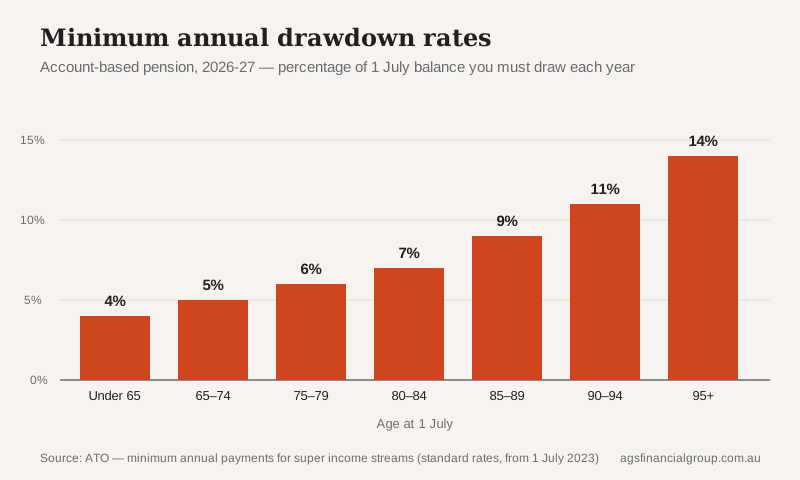
| Age at 1 July | Minimum drawdown |
|---|---|
| Under 65 | 4% |
| 65 to 74 | 5% |
| 75 to 79 | 6% |
| 80 to 84 | 7% |
| 85 to 89 | 9% |
| 90 to 94 | 11% |
| 95 and over | 14% |
These are the standard rates that have applied since 1 July 2023, after the temporary halved rates used during the pandemic years ended. A worked example: a 70-year-old with a $600,000 balance on 1 July must draw at least 5%, which is $30,000 across the year. They can take more, but not less. The minimum is recalculated each 1 July against the new balance, so a market fall or a few years of drawdowns lowers next year’s required payment.
There’s no maximum on an ordinary account-based pension. You can draw a lump sum on top of your regular payments whenever you need to, which is useful for a car, a holiday or a health cost. (A transition to retirement pension, taken before you fully retire, works differently and does cap withdrawals at 10%.)
How it’s taxed
Once you turn 60, the income from an account-based pension is tax-free and doesn’t go on your tax return. Earnings inside the account are also tax-free in retirement phase. For most retirees that means the pension arrives in full, with nothing withheld and nothing owing.
Before 60 the position is different. If you’ve met a condition of release and started a pension between your preservation age and 60, the taxable portion of each payment is taxed at your marginal rate with a 15% offset. Since preservation age is now 60 for anyone born on or after 1 July 1964, this earlier-access situation applies to fewer people each year.
The transfer balance cap
Because retirement-phase earnings are tax-free, there’s a ceiling on how much super you can move into that phase. The general transfer balance cap rose to $2.1 million on 1 July 2026, up from $2.0 million, indexed in $100,000 steps with CPI. The amount that applies to you personally depends on when you first started a retirement-phase pension and how much of your cap you’ve already used.
Super above the cap can stay in your accumulation account, where earnings are taxed at up to 15%, or come out of the system entirely. For couples, the cap applies per person, so a household can hold up to twice the cap across two pensions if both balances support it. Getting the split right between partners is a common piece of retirement planning work in the years before you start drawing.
Centrelink and the age pension
An account-based pension counts under both the assets test and the income test for the age pension. The account balance is an assessable asset, and Centrelink applies deeming to it to work out an assessed income, the same way it treats most financial investments. The actual pension payments you draw aren’t counted separately on top of the deemed amount.
That deeming treatment matters because it means a large account-based pension can reduce or remove an age pension entitlement. Whether you qualify for a part pension depends on your whole position, and it interacts with the age pension assets test thresholds and your other assets. Modelling the two together, your super income and any age pension, is where a plan earns its place.
Making the money last
The flexibility of an account-based pension is also its risk. Because the balance isn’t guaranteed, two things can shorten its life: drawing too much, and a poor run of investment returns early in retirement.
That second risk has a name, sequencing risk. A market fall in your first few years of retirement does more damage than the same fall later, because you’re selling units to fund your income at depressed prices and there’s less time to recover. A 2008-style year early in retirement can take years off how long a balance lasts, even if average returns over the full period look fine.
The usual defences are practical. Hold a cash or conservative buffer to fund a year or two of income so you’re not forced to sell growth assets in a downturn. Keep the drawdown sustainable rather than drawing the maximum the account allows. Review the investment mix so it’s neither too defensive to keep pace with a 30-year retirement nor too aggressive for the income you depend on. None of that removes market risk, but it changes how exposed your income is to it.
An account-based pension suits people who want flexibility and the chance of growth, and who can tolerate a balance that moves with markets. Retirees who want a guaranteed income for life sometimes pair one with a lifetime income stream or annuity, using the account-based pension for flexibility and the lifetime product for certainty.
Where advice fits
The account-based pension itself is straightforward to open. The decisions around it are where the value sits: how much to move across against the transfer balance cap, how to invest it for a retirement that may run 30 years, how much to draw, how it meshes with any age pension, and how a couple splits balances between them. Our retirement planning and superannuation teams model these together from all eight AGS offices across Sydney, Melbourne and Brisbane, so the income you start matches the retirement you’re planning for.