
— Free 30-minute discussion
Turn a lower tax bill into faster wealth building
The extra take-home pay is only the start. Structuring your super contributions, investments and debt around the new brackets is where a strategic plan compounds the benefit. A free 30-minute strategy session will show you where that opportunity sits for your situation. No cost, no obligation.
Book a free strategy sessionKey points
- The tax-free threshold is $18,200. It has not changed.
- The rate on income between $18,201 and $45,000 dropped from 16% to 15% on 1 July 2026 (ATO).
- The 30% bracket runs from $45,001 to $135,000, then 37% to $190,000, then 45% above that.
- A 2% Medicare levy applies on top of these rates for most taxpayers.
- The same first-bracket rate is legislated to fall again to 14% on 1 July 2027.
Australia taxes personal income on a sliding scale. Each slice of your income is taxed at the rate for the bracket it falls in, and only that slice. This is the part most people get wrong: moving into a higher bracket does not increase the tax on the income you already earned below it.
The scale changed on 1 July 2026. The rate applying to the first taxable bracket came down from 16% to 15%, the second step of the cost-of-living cuts legislated in 2025. It’s a small change in percentage terms and a meaningful one in a full year for anyone earning above $45,000.
Resident tax rates 2026-27
These rates apply to Australian residents for tax purposes for the income year running 1 July 2026 to 30 June 2027.
| Taxable income | Tax on this income |
|---|---|
| $0 to $18,200 | Nil |
| $18,201 to $45,000 | 15c for each $1 over $18,200 |
| $45,001 to $135,000 | $4,020 plus 30c for each $1 over $45,000 |
| $135,001 to $190,000 | $31,020 plus 37c for each $1 over $135,000 |
| $190,001 and over | $51,370 plus 45c for each $1 over $190,000 |
The figures above exclude the Medicare levy, which is a separate 2% on most taxable income.
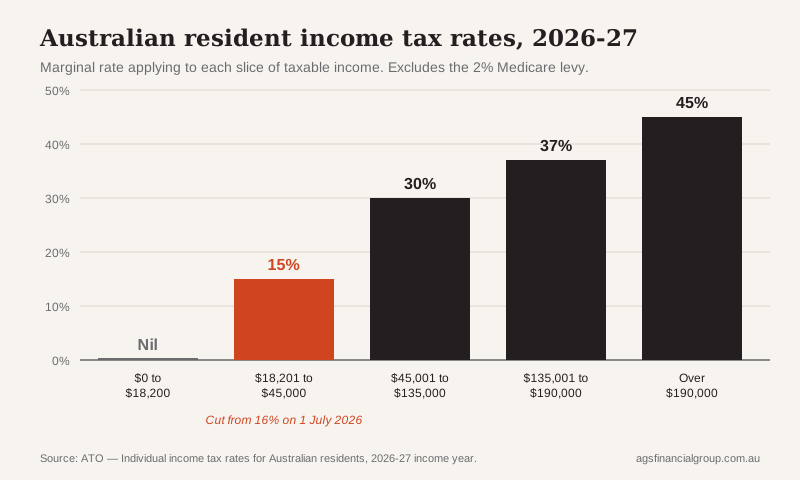
What changed on 1 July 2026
One number moved. The second bracket, covering income from $18,201 to $45,000, went from 16c in the dollar to 15c.
Because that bracket spans $26,800 of income, anyone whose taxable income reaches $45,000 or more gets the full benefit of the cut: $268 across the year, before the Medicare levy. Someone earning $35,000 gets a proportion of it. The saving stops growing after $45,000, so a person on $60,000 and a person on $300,000 receive the same $268 from this particular change.
A further cut is already legislated. The same bracket falls to 14c from 1 July 2027.
How marginal rates work
Your marginal rate is the rate on your next dollar of income. Your average rate is the total tax divided by total income, and it is always lower.
Take a taxable income of $95,000 in 2026-27:
- The first $18,200 is untaxed.
- The next $26,800 is taxed at 15%, which is $4,020.
- The remaining $50,000 is taxed at 30%, which is $15,000.
Total tax is $19,020 before the Medicare levy. The marginal rate is 30%, but the average rate is about 20%. Add the 2% levy and the total becomes $20,920.
This matters when people consider extra work, a bonus, or an investment that adds income. The extra income is taxed at the marginal rate, not at some higher penalty rate, and the tax on existing income is unaffected.
Weekly and fortnightly tax tables
The scale above is the annual one. Most people meet it in a different form, as the amount an employer takes out of each pay. Those are the PAYG withholding tax tables, and they are usually what a search for “tax tables” or “tax scales” is after.
The withholding tables are built from the same marginal rates, just spread across a pay cycle. The ATO publishes a weekly, fortnightly and monthly version, and payroll software applies the right one automatically. An employer reads your gross pay for the period against the table, withholds that amount, and sends it to the ATO on your behalf. The published tables sit on the ATO website and update when the rates change, as they did on 1 July 2026.
Two points matter here. The withholding is an estimate, not your final tax. It assumes you earn the same amount every period all year, claim the tax-free threshold with one employer, and have nothing else going on. Your real tax is worked out at year end against the annual scale, and the difference between what was withheld and what you owe is your refund or your bill.
The estimate also breaks down when your income is not a steady salary. A second job, commission, or investment income on top of wages tends to leave you under-withheld, because each payer treats its slice as though it were your only income. Someone with two jobs who claims the tax-free threshold on both is the classic case, and it is why a return can produce a bill rather than a refund.
The traps in the scale
A pay rise never leaves you worse off. Crossing a bracket applies the higher rate only to the amount above the threshold. There is no point on the resident scale where earning one more dollar reduces take-home pay.
The Medicare levy surcharge is separate. People without an appropriate level of private hospital cover may pay an additional 1% to 1.5% once income passes the surcharge threshold. That one does step, so it can be worth checking against the cost of cover.
Division 293 affects higher earners’ super. Where combined income and concessional super contributions exceed $250,000, an extra 15% applies to some or all of those contributions.
The scale above is for residents. Foreign residents pay from the first dollar with no tax-free threshold, and working holiday makers are on a different scale again. Residency for tax is not the same as residency for immigration.
Offsets are not deductions. The low income tax offset, worth up to $700, reduces tax payable rather than taxable income, and it is not refundable. It can take your tax to nil but not below.
Where the rate scale drives decisions
The gap between the 30% bracket and the 15% super contributions tax is the reason salary sacrificing into super is worth modelling for many employees. Contributing pre-tax income taxed at 30%, 37% or 45% into an environment taxed at 15% is a difference of 15 to 30 cents in the dollar, within the concessional contribution caps.
Business owners face a related question. Income taxed in a company sits at 25% or 30% depending on turnover and activity, which sits below the top personal rates but is not free money, because getting it out to an individual triggers further tax. Our business tax team works through the timing of that with owners each year.
For individuals, the practical work is usually less dramatic: claiming what is genuinely deductible, timing income and deductions across two income years where there is a choice, and keeping records that hold up. Our individual tax team handles returns from all six AGS offices across Sydney, Melbourne and Brisbane.
Rates are only half the calculation
The scale determines the rate. Taxable income determines what the rate applies to, and that is where most of the variation between two people on the same salary comes from. Deductions, offsets, investment income, capital gains, and super contributions all move the number the rate is applied to.
Anyone whose position involves more than salary and a handful of deductions will get more out of a conversation about taxable income than about brackets. The brackets are fixed and public. What lands inside them is where the planning happens, and it depends heavily on individual circumstances.
Rates and thresholds in this article are current for the 2026-27 income year and come from the ATO. They are reviewed each Federal Budget.