
— Free 30-minute discussion
Facing a capital gain, or the 2027 changes?
The right CGT decision turns on your income, your assets and the year you sell, and the rules shift from 1 July 2027. Book a free initial discussion and we'll understand your situation and map how AGS can help, whether you're timing an investment sale or planning a business exit.
Book a free initial discussionKey points
- A capital gain is added to your taxable income and taxed at your marginal rate. There’s no separate CGT rate.
- Individuals and trusts get a 50% discount on gains from assets held more than 12 months. Companies don’t.
- Your main residence is generally exempt, and the six-year rule can extend that after you move out.
- Small business owners can access concessions that reduce, defer or wipe out a gain on a business sale, including a 15-year exemption and a $500,000 retirement exemption.
- For gains accruing from 1 July 2027, Parliament has replaced the 50% discount with CPI cost-base indexation and added a minimum 30% tax on real gains. The year to 30 June 2027 is a genuine planning window.
Capital gains tax touches almost every investor and business owner in Australia at some point: when you sell shares, an investment property, crypto, or a business. It isn’t a tax you pay as you go. It lands in the year you sell, and how much you pay depends on how long you held the asset, your income that year, and the structure you own it through. Get the timing and the structure right and the difference can be large.
This guide covers how CGT works today, the main exemptions and concessions, and the changes that start for gains from 1 July 2027. The rules are moving, so the value is in planning against the current facts rather than last year’s.
How capital gains tax works
A capital gain arises on a CGT event, which for most people means selling or disposing of an asset. The gain is the sale proceeds minus the asset’s cost base (broadly what you paid, plus buying and improvement costs). A loss arises when the cost base is higher than the proceeds.
You tally your gains and losses for the year. Capital losses offset capital gains, not your salary or business income, and any unused loss carries forward indefinitely until a future gain uses it up. What’s left after losses, and after any discount, is your net capital gain. That figure is added to your assessable income and taxed at your marginal rate, alongside everything else you earned that year.
Two things follow from that. A gain in a high-income year costs more than the same gain in a low-income year. And a year with a large gain can push you into a higher bracket, so the timing of a sale is a lever worth using.
The 50% CGT discount
Individuals and trusts who hold an asset for more than 12 months before selling get a 50% discount on the gain. You’re taxed on half of it. Hold for 11 months and you’re taxed on all of it, which makes the 12-month mark one of the simplest planning points in the system. Self-managed super funds get a one-third discount. Companies get no discount at all, which is one reason the structure you hold an asset in matters as much as the asset itself.
The discount applies after you’ve offset capital losses, not before. So you use losses against the undiscounted gain first, then discount what remains.
Your home and CGT
Your main residence is generally exempt from capital gains tax, which is why the family home rarely comes up in a CGT conversation. A few situations narrow that exemption.
The six-year rule lets you move out of your home, rent it out, and still treat it as your main residence for up to six years, so a sale within that window stays exempt. If the property isn’t earning income, you can treat it as your main residence indefinitely. Moving back in resets the six-year clock. You can only have one main residence at a time, so couples and people with more than one property need to choose deliberately.
Using part of your home to produce income, running a business from it, or holding it through a company or trust can each reduce or remove the exemption. These are the situations where a quick check before you act saves far more than it costs.
Shares, crypto and inherited assets
Shares and managed funds follow the standard rules: a CGT event on sale, the 50% discount after 12 months, losses offsetting gains. Reinvested distributions and franking add detail, so your cost base is rarely just the purchase price.
Crypto is a CGT asset too, and every disposal counts, including swapping one coin for another, not only cashing out to dollars. We cover the detail in our guide to crypto tax in Australia.
Inherited assets have their own rules: you generally inherit the deceased’s cost base and acquisition date for assets bought after CGT started in 1985, which can carry a large embedded gain into your hands. Assets held inside super have separate treatment again, including inside an SMSF, where the fund’s own CGT position matters. See managing CGT in an SMSF for that.
Small business CGT concessions
Business owners have access to concessions that most investors don’t, and they can be the difference between a taxable windfall and a tax-free one on a business sale. You need to meet the basic conditions first: broadly, net assets under $6 million or a small business turnover test, and the asset has to be an active asset used in the business.
Meet those and up to four concessions can apply:
- 15-year exemption. Own the active asset for at least 15 years, be 55 or over and retiring (or permanently incapacitated), and the whole gain can be disregarded.
- 50% active asset reduction. A further 50% reduction on top of the general discount, so a large part of the gain can drop away.
- Retirement exemption. Up to $500,000 of gains exempt over your lifetime, paid into super if you’re under 55.
- Rollover. Defer the gain by reinvesting in a replacement active asset, generally within two years.
They interact, they stack in a particular order, and the conditions are strict. Getting the sequence right on a business sale is one of the highest-value pieces of tax work we do, and it’s worth mapping years ahead of a sale, not in the month you sign. Our business tax team runs this with owners as part of exit planning, and the structure you built the business in (covered in our business structure and tax guide) shapes what’s available.
Reducing your CGT
Within the rules, several levers reduce a capital gains bill:
- Hold past 12 months to earn the discount.
- Time the sale into a lower-income year where you can, so the gain is taxed at a lower marginal rate.
- Harvest losses by realising an underperforming asset in the same year as a gain, so the loss offsets it.
- Use the small business concessions if you qualify.
- Make a deductible super contribution in the year of a large gain to reduce your overall taxable income, within the $32,500 concessional cap.
Each depends on your circumstances and the year the gain falls in, which is why the planning happens before the sale, not at tax time.
What changes from 1 July 2027
The biggest change to CGT in a generation is partly law and partly still being written. The first stage, the Treasury Laws Amendment (Tax Reform No. 1) Act 2026, passed Parliament in June 2026 and applies to capital gains that accrue from 1 July 2027. It doesn’t touch your 2025-26 return, and it only starts to bite from the 2027-28 year, once a CGT event happens on or after the start date.
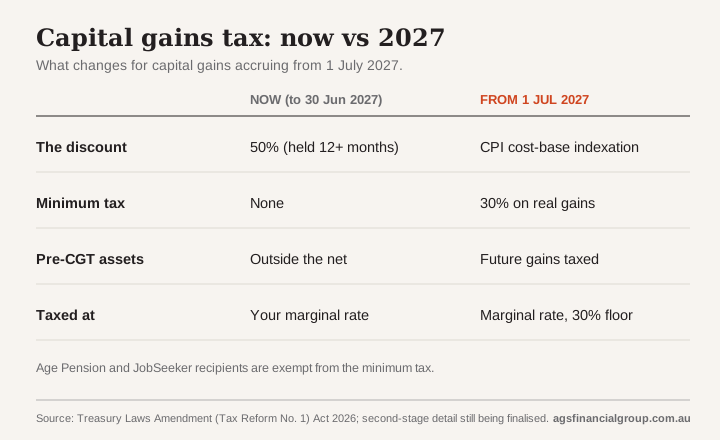
What’s now law. For gains accruing from 1 July 2027:
- The 50% discount is replaced by cost-base indexation for resident individuals, trusts and partnerships. Instead of halving the gain, your cost base is lifted by inflation (CPI), so you’re taxed on the real gain above inflation rather than through a flat 50% reduction.
- A minimum 30% tax applies to certain net capital gains, setting a floor on what a real gain is taxed at. For many people already on higher marginal rates it won’t add tax. For others it will.
- Pre-CGT assets come into the system. Assets acquired before 20 September 1985 have sat outside CGT entirely. From 1 July 2027, their future gains are taxed.
- Age Pension and JobSeeker recipients are exempt from the minimum tax.
What’s still being finalised. A second stage, the Treasury Laws Amendment (Tax Reform No. 3) Bill, remains in progress after its consultation closed. It covers the method for splitting a gain into its pre- and post-1 July 2027 parts, and the treatment of small and start-up businesses. In late October 2026 the government added a 50% CGT concession for eligible innovative start-up equity, shielding qualifying founders, employees and investors from the new minimum tax. More detail is due before the start date.
The transition matters most for assets you already hold. For anything owned before 1 July 2027, the gain up to that date stays under today’s rules, including the 50% discount where it applies, and only the gain after that date moves to indexation and the minimum tax. You may eventually need the asset’s market value immediately before 1 July 2027 to split the two. The ATO’s guidance is not to get a valuation before that date, and the apportionment method is still being developed, so the task now is to understand your position rather than rush a valuation.
Whether these changes leave you better or worse off depends on your marginal rate, how long you’ve held the asset, and how much of the gain is real rather than inflation. For a long-held asset where inflation has done much of the work, indexation can be kinder than the old discount. For a short, sharp gain it can be harsher. The year to 30 June 2027 is a genuine planning window: gains realised before then still use today’s rules.
The same reform package also limits negative gearing on residential property to new builds from 1 July 2027. Property bought before the 12 May 2026 Budget announcement is exempt, so existing arrangements continue.
Planning around a moving target
This is where it helps to have planning and accounting under one roof. The right CGT decision depends on your income, your other assets, your structure and the year you sell, and from 1 July 2027 it depends on rules that are still being finalised. A move that looks smart in isolation can cost more once you factor in your marginal rate or a concession you’ve overlooked.
Whether you’re an investor weighing when to sell, or a business owner planning an exit, AGS helps you optimise the decision against the current facts, and adjust as they change. If you’re sitting on a gain or a decision you’re unsure about, talk to our team. Our accountants and financial planners coordinate the tax, timing and structure together, so you’re acting on the whole picture rather than one part of it.