
— Free 30-minute discussion
Not sure you're making the most of your super?
How you contribute, where your super is invested and how it's structured all shape your retirement income. Book a free initial discussion and we'll understand your position and map how AGS can help.
Book a free initial discussionKey points
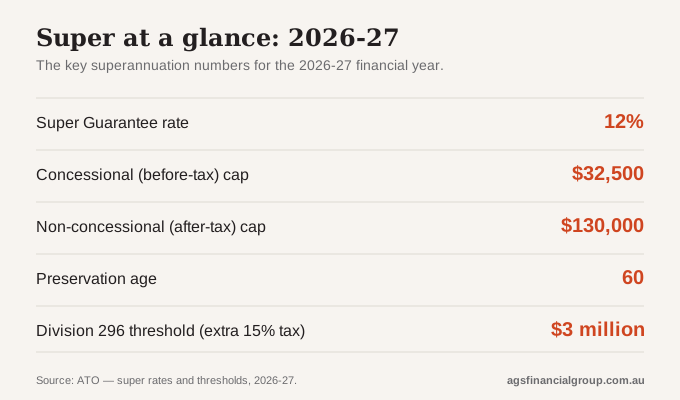
- The Super Guarantee rate is 12% for 2026-27, and from 1 July 2026 it’s paid every payday, not quarterly.
- The concessional (before-tax) cap is $32,500 and the non-concessional (after-tax) cap is $130,000 for 2026-27.
- You can generally access super at age 65, or at preservation age 60 once you’ve retired.
- Division 296 adds a further 15% tax on earnings tied to a super balance between $3 million and $10 million, and 25% above $10 million, from 1 July 2026.
- A couple needs about $730,000 and a single about $630,000 for a comfortable retirement from 67 (ASFA, June quarter 2026).
Superannuation does a lot of work for most Australians, and the rules around it change often enough that even confident savers lose track. These are the questions we field most at AGS, answered for the 2026-27 year. Each one links to a deeper guide if you want the full detail.
How super is taxed
Contributions fall into two buckets. Concessional contributions are before-tax money your employer or you have claimed a deduction on. Non-concessional contributions come from after-tax income, including most personal contributions and government co-contributions.
Concessional contributions are taxed at 15% on the way into the fund. Low-income earners get an offset, and people earning over $250,000 (including super) pay an extra 15% under Division 293. Non-concessional contributions aren’t taxed on entry.
Investment earnings are taxed at 15% while your super is in accumulation phase. From age 60, earnings in the retirement (pension) phase and any withdrawals are generally tax-free. One newer rule matters for large balances: Division 296 adds a further 15% tax on earnings tied to the portion of a total super balance between $3 million and $10 million, and 25% on the portion above $10 million, from 1 July 2026. Both thresholds are indexed.
Contributing to super
If you’re over 18 and employed, your employer contributes 12% of your earnings under the Super Guarantee. You can add to that in several ways:
- Salary sacrifice. Ask your employer to divert some pre-tax pay into super as concessional contributions.
- Personal contributions. Pay in from after-tax income. Claim a deduction and they count as concessional; don’t, and they’re non-concessional.
- Government co-contribution. Lower-income earners who make a personal after-tax contribution can receive up to $500 from the government.
- Spouse contribution. Contribute for a low-income spouse and claim a tax offset of up to $540.
- Downsizer contribution. Over-55s who sell a long-held home can put up to $300,000 each into super outside the usual caps.
The caps bind all of this. For 2026-27 the concessional cap is $32,500 and the non-concessional cap is $130,000. If your total super balance was under $1.84 million on 30 June 2026, the bring-forward rule can let you contribute up to $390,000 of non-concessional money across three years. Work tests apply to some contributions after age 67.
Accessing your super
Super is preserved until you meet a condition of release. The common ones:
- You turn 65, whether or not you’re still working.
- You reach preservation age (now 60 for anyone born on or after 1 July 1964) and have retired.
- You start a transition to retirement income stream while still working.
Beyond those, early access is tightly limited to cases like severe financial hardship, specific medical conditions, and the First Home Super Saver Scheme. The full list of rules sits in our guide to accessing your super.
How much you need to retire
This question usually means one thing: give me a number. The ASFA Retirement Standard is the closest thing Australia has to an agreed one. Its June quarter 2026 figures put a comfortable retirement at about $730,000 in super for a couple and $630,000 for a single, assuming you own your home and retire at 67. A modest retirement needs far less, because it leans heavily on the Age Pension.
Those are benchmarks, not targets that fit everyone. What you need turns on your spending, whether you own your home, and when you stop work. Our guide to how much you need to retire in Australia walks through building your own figure.
Leaving super to family
Your super doesn’t automatically pass under your Will. If your fund allows a binding death benefit nomination, you can direct your balance to your legal personal representative, so it’s distributed through your estate, or straight to a superannuation dependant. Under super law, dependants are your spouse (including de facto and same-sex partners), your children, a financial dependant, or someone you had an interdependency relationship with.
Without a valid binding nomination, the fund trustee decides who receives your death benefit. A non-binding nomination guides that decision but doesn’t control it. There can also be tax on benefits paid to non-dependants, which is why this is worth getting right. Our article on what happens to your super when you die covers the tax and nomination detail.
Making the most of super
For most people super is still the most tax-effective place to build retirement savings. The rules reward people who plan ahead: using the full concessional cap, timing larger non-concessional contributions, choosing the right investment mix for your age, and keeping an eye on your total balance against the $3 million threshold. A self-managed super fund gives some families more control over investments and structure, though it brings more responsibility too.
Getting the settings right across super, tax and your broader plan is where advice earns its keep. If you’d like a second opinion on your contributions, fund choice or retirement projection, talk to the AGS team. Our financial planners and accountants coordinate the super, tax and cashflow sides together.
Frequently asked questions
How is my super taxed? Concessional (before-tax) contributions are taxed at 15% going in, with a low-income offset and an extra 15% (Division 293) for incomes over $250,000 including super. Non-concessional (after-tax) contributions aren’t taxed on entry. Earnings are taxed at 15% in accumulation phase, and from age 60 earnings in pension phase and withdrawals are generally tax-free.
How much can I contribute to super in 2026-27? The concessional cap is $32,500 and the non-concessional cap is $130,000. If your total super balance was under $1.84 million on 30 June 2026, you may be able to bring forward up to $390,000 of non-concessional contributions over three years.
When can I access my super? At 65 even if still working, at preservation age 60 once you’ve retired, or through a transition to retirement income stream. Early access applies only in limited cases such as severe financial hardship, certain medical conditions, and the First Home Super Saver Scheme.
How much do I need to retire? ASFA (June quarter 2026) estimates a couple needs about $730,000 and a single about $630,000 for a comfortable retirement from 67, assuming home ownership. Your own figure depends on your spending and circumstances.
Who can I leave my super to? With a binding nomination, to your legal personal representative or a superannuation dependant (spouse, child, financial dependant, or interdependant). Without one, the fund trustee decides.
What is the super rate in 2026-27? The Super Guarantee rate is 12%. From 1 July 2026 it’s paid every payday rather than quarterly, on a broader base called Qualifying Earnings. The rate itself is unchanged.