
Key points
- A comfortable retirement now costs a couple $77,375 a year and a single $54,837 a year (ASFA, March quarter 2026).
- A modest retirement costs a couple $52,473 and a single $36,434 a year, and leans heavily on the Age Pension.
- To fund a comfortable retirement from age 67, ASFA estimates a couple needs $730,000 in super and a single $630,000, assuming they own their home.
- Those lump sums rose for the first time in three years, pushed up by grocery, insurance, energy and health costs.
Most people asking “how much do I need to retire?” want a number, not a lecture. The ASFA Retirement Standard is the closest thing Australia has to an agreed answer. It is published every quarter by the Association of Superannuation Funds of Australia and it translates a retirement lifestyle into a yearly budget, then into the super balance behind it.
The figures below are the March quarter 2026 release. They are a useful benchmark to test your own plan against. They are not a target that fits everyone, and that distinction matters more than the headline number.
What the standard measures
ASFA models two retirement lifestyles for a person who owns their home outright and is broadly healthy.
- Comfortable. Private health cover, a reasonable car, regular restaurant meals, domestic travel and an occasional overseas trip, and enough left over for home maintenance and technology.
- Modest. Better than the Age Pension alone, but basic. Cheaper activities, limited travel, an older car, and little room for a large one-off cost.
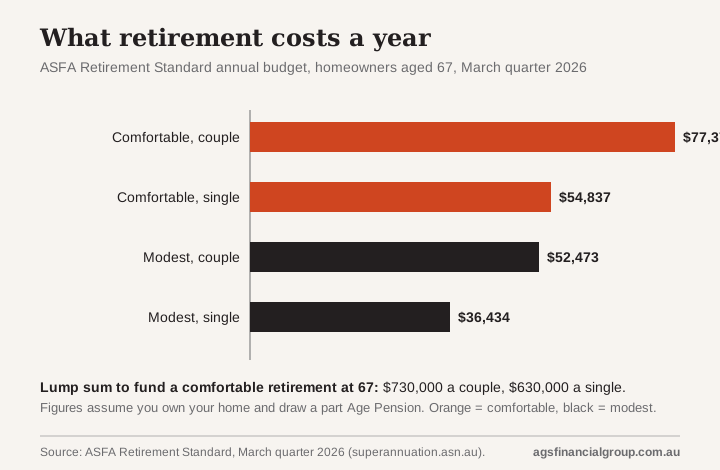
ASFA works back from those yearly budgets to the super behind them. To fund a comfortable standard from age 67, it estimates $730,000 for a couple and $630,000 for a single. Both assume you draw a part Age Pension as your balance runs down, and both assume the home is paid off.
Why the modest lump sum looks so low
ASFA puts the lump sum for a modest retirement at roughly $110,000 to $120,000, far below the comfortable figure. That gap exists because a modest budget is close to what the full Age Pension already provides, so a retiree only needs a small top-up.
It means the modest standard depends almost entirely on the Age Pension. Any change to pension rates or the assets test moves it. A comfortable retirement leans the other way. Most of the income comes from your own superannuation and investment returns, with the pension as a supplement rather than the foundation.
Where the standard stops being useful
The Retirement Standard is built on two assumptions that do not hold for everyone: you own your home, and you spend at a steady rate for life. Break either one and the number shifts.
If you rent in retirement, neither budget covers your housing. Rent in most capital cities would add $20,000 or more a year, which changes the picture entirely and usually means a larger balance or a longer working life.
Spending is rarely flat. Retirement spending tends to run higher in the active early years, ease through the quieter middle years, then rise again late in life as health and care costs climb. A single averaged figure hides that shape. Planning to the average can leave you short in the years you most want to travel, or over-saving for a lifestyle you have slowed down from.
The standard ignores tax, and that cuts in your favour. Once you are over 60 and drawing from a super pension, that income is generally tax free. So the gross salary you would need to replace a comfortable budget while working is considerably higher than the budget itself.
How to use the number
Treat the standard as a reference point, then adjust for your own situation.
- Start with your spending, not the benchmark. Twelve months of real bank statements tells you more than any national average. Some retirees are comfortable well under the ASFA figure. Others spend above it and are happy to.
- Add back what the standard leaves out. Rent, an outstanding mortgage, private school fees running into retirement, or support for adult children all sit outside the model.
- Check your trajectory, not just your balance. A retirement projection shows whether your current contributions and investment mix land you near the comfortable number by the age you want to stop. If there is a gap, a decade of extra concessional contributions closes far more of it than the same effort in the final few years.
- Model the drawdown, not only the target. The balance you retire with matters less than how long it lasts. Sequencing, the pension interaction and your withdrawal rate decide that, and they reward planning.
Business owners and SMSF trustees usually aim well past the comfortable number. The same modelling applies, with wider levers: contribution timing, the assets held inside the fund, and how a business sale feeds the balance. Mapping those out years ahead makes a real difference to the balance you retire with.
The ASFA numbers give you a shared language for a hard question. The right target for you is a different figure, built from your own costs, your home situation and the retirement you actually want. If you would like to see where your plan lands against it, the AGS financial planning team runs the projection with you in a free initial discussion.