
Key points
- Australia taxes your worldwide income, so an overseas pension generally becomes reportable here once you are a resident.
- An account that was tax-free or tax-deferred at home, a Canadian TFSA, a US Roth IRA, a 401(k), is usually not treated the same way in Australia.
- Most foreign retirement accounts cannot be moved into Australian super. A UK pension (only to a QROPS, in practice an SMSF) and KiwiSaver are the main exceptions.
- Overseas pensions and balances still count towards the Age Pension income and assets tests.
Plenty of people arrive in Australia with a pension sitting in another country and quietly leave it in the too-hard basket. The rules look complicated, the account is thousands of kilometres away, and it never feels urgent. Then retirement arrives and the questions all land at once: how is it taxed, can I move it, and does it affect my Age Pension?
The complexity is real. It is also the reason to deal with it early rather than late. Most of the expensive mistakes we see, a forgotten scheme, a defined benefit guarantee given up for nothing, a tax bill nobody planned for, come from leaving an overseas account out of the plan, not from the account itself. An overseas pension adds a layer to your retirement. It does not have to be a barrier to it.
What changes when you live in Australia
Australia taxes residents on their worldwide income. The day you become a tax resident, your overseas pension generally becomes something you report here, and the tax concession it carried at home usually does not come with it.
Two international agreements do most of the work. A Double Tax Agreement between Australia and the other country decides who gets to tax what, so you are not taxed twice on the same income. A Social Security Agreement is a separate thing entirely, covering whether periods you worked overseas count towards a government pension. They solve different problems, and people often assume one covers both. It does not.
The practical upshot: your overseas pension income is generally assessable in Australia, with a foreign income tax offset for tax already paid at the source. How much, and when, depends on the country, the type of account and the treaty.
”Tax-free at home” is not tax-free here
This is where the biggest surprises sit. A tax status earned under another country’s rules does not automatically survive the move to Australian residency.
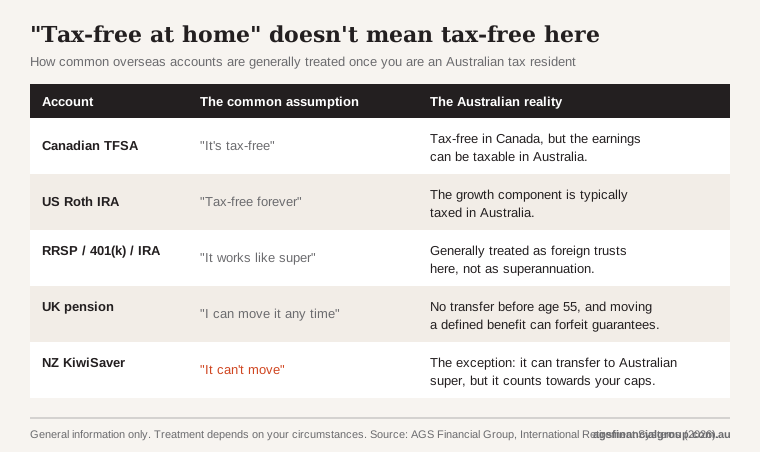
A Canadian TFSA is tax-free in Canada, but its earnings can be taxable to an Australian resident. A US Roth IRA is sold as tax-free forever, yet the growth component is typically taxed here. A 401(k), a Traditional IRA and an RRSP feel like they should work like super, but Australia generally treats them as foreign trusts, which is a different and often less favourable regime. None of this is a reason to panic. It is a reason to get the Australian tax position mapped before you draw on the account or move it, not after.
Can you bring it to Australia?
“Can I transfer it?” and “should I transfer it?” are different questions, and the honest answer to the first is usually no.
- UK pensions. A UK pension can only move to a Qualifying Recognised Overseas Pension Scheme, which in practice means an Australian SMSF. You cannot transfer before age 55, transfer charges can apply, and moving a legacy defined benefit scheme can mean giving up a guaranteed income that is worth more than the transfer value. This is the decision that most needs specialist, UK-aware advice before you act.
- NZ KiwiSaver. KiwiSaver is the rare account that can move across to Australian super. It is not taxed on the way in, but the balance counts towards your contribution caps, so timing matters.
- US and Canadian accounts. A 401(k), IRA or RRSP generally cannot be transferred into super at all. The route is to withdraw and then contribute, which triggers tax and, for under-59½ US withdrawals, a penalty. Often the better answer is to leave it where it is and plan the drawdown.
We are not an overseas-pension transfer specialist, and we will say so when a transfer decision needs advice from a provider regulated in the country the money sits in. What we do is give you the clear Australian tax and planning picture so that decision is an informed one.
Currency is part of the plan
If you retire in Australia but your pension pays in pounds, dollars or NZD, your real spending power moves with the exchange rate. The swings are not small. A £20,000 UK pension was worth roughly A$45,600 in 2008. By 2012 the same £20,000 bought about A$29,600 (ATO average annual exchange rates). A third of your income can move without you changing anything. Building that reality into the plan, through timing and a sensible mix of income sources, is part of the work.
It still counts for the Age Pension
Overseas pensions and account balances do not sit outside the system. They count towards the Age Pension income and assets tests, the same as an Australian asset would. Leaving a foreign account out of your Centrelink picture is one of the easier ways to get an unwelcome surprise, and one of the easier ones to avoid with planning.
One plan, not five
The point of pulling all this together is simple. Your retirement income comes from a few sources at once: government pensions here and overseas, Australian super, your overseas accounts, and your personal investments. Planned separately they pull against each other. Planned together they become one income stream with the tax, the currency and the Age Pension handled deliberately.
This is what our overseas-pension planning is built for. The accounting team handles the Australian tax and reporting on your foreign income, and the financial planning team factors the overseas money into your retirement plan, working from the same picture. If you have a pension or account sitting overseas and you are not sure where it fits, a free initial discussion is the place to start. You will leave with the clear Australian picture, and you do not have to decide anything on the day.
For the mechanics of the UK State Pension and National Insurance years specifically, see our guide to UK State Pension entitlements.