
Key points
- GST registration is compulsory once turnover reaches $75,000 a year (ATO).
- A base rate company pays 25% tax; the standard company rate is 30% (ATO).
- Employers must pay the Super Guarantee at 12% on eligible wages (ATO).
- An ABN should be registered before you invoice; PAYG withholding applies once you employ staff.
- Keep business and personal money in separate accounts from day one.
Most new businesses fail on cash flow and admin long before they fail on the idea. Getting the financial foundations right in the first few months won’t guarantee success, but getting them wrong will cost you time, money and sleep. This is a plain guide to what a new owner needs to set up, and in what order.
It’s general information rather than advice for your situation. The right structure and registrations depend on what you’re building and how you plan to grow.
Get the structure right first
Before you register anything, decide how the business will be owned. Sole trader, partnership, company and trust each carry different tax, liability and cost profiles. A sole trader setup is cheap and simple, and your business income is taxed at your personal marginal rate. A company caps tax at the company rate and separates your personal assets from business risk, at the cost of more paperwork and annual fees.
Changing structure later is possible, but it can trigger capital gains tax and legal cost, so it’s worth getting close to right at the start. Our guide to choosing a business structure walks through the trade-offs in detail.
Registrations you’ll need
Once the structure is set, the registrations follow a fairly standard path.
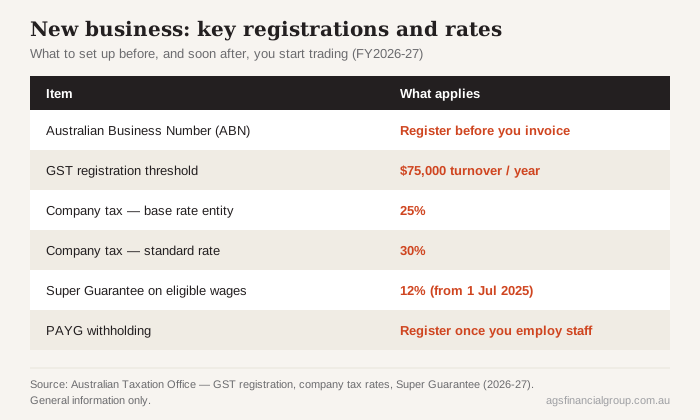
- ABN. Register an Australian Business Number before you send your first invoice. Without one, other businesses may have to withhold tax from payments to you.
- GST. Registration becomes compulsory once your turnover hits $75,000 a year. Below that it’s optional, though registering early lets you claim GST credits on start-up purchases.
- PAYG withholding. If you’ll employ staff, register to withhold tax from their wages and remit it to the ATO.
- Business name. Register the trading name with ASIC unless you’re trading under your own name.
Getting these in place early avoids the scramble that happens when the first big invoice or first employee arrives and the paperwork isn’t ready.
Separate business and personal
Open a dedicated business bank account on day one and run everything through it. Mixing personal and business money is the single most common bookkeeping problem I see in new businesses, and untangling it at tax time is slow and expensive.
A separate account does three things. It makes your bookkeeping accurate, it gives you a clear view of what the business is actually earning, and it protects you if the ATO ever asks how a figure was reached. Pay yourself a regular transfer from the business account rather than dipping into it directly.
Bookkeeping from day one
Good records aren’t about pleasing the tax office. They’re how you know whether the business is making money. Set up cloud accounting software early, connect it to the business bank account, and reconcile it regularly so the numbers stay current.
Done well, bookkeeping gives you real-time visibility of cash flow, makes your BAS and tax return faster, and flags problems while there’s still time to act. Done badly, or left in a shoebox until June, it hides exactly the problems you needed to see. Many owners hand this off early so they can focus on the business itself. Our bookkeeping service sets up the software correctly and keeps it reconciled, which feeds straight into the annual tax work.
Set money aside for tax
New owners are often surprised by their first tax bill, because early revenue feels like income when a chunk of it belongs to the ATO. Build the habit of setting money aside from the start.
As a rough discipline, move a percentage of every payment received into a separate tax account, covering income tax, and GST if you’re registered. The exact figure depends on your structure and margin, but the principle holds: the money you owe in tax was never really yours to spend. Employers also need to budget for the Super Guarantee, now 12% of eligible wages, paid on the required schedule.
When to bring in an accountant
You can run the basics yourself, and plenty of owners do at the start. The point to bring in an accountant is when a decision has a lasting cost: choosing the structure, deciding when to register for GST, taking on the first employee, or planning how to draw profit tax-effectively. Those are the calls that are cheap to get right early and expensive to fix later.
If you’re setting up around Sydney, our North Sydney accounting team works with new businesses across the lower North Shore on structure, registrations and the first year of compliance. Our broader accounting and tax service covers the same ground nationally, and the guide on how to choose a tax accountant is a good place to start if you’re comparing options.
Frequently asked questions
When do I have to register for GST? Once your business turns over $75,000 or more in a year, GST registration is compulsory. You can register voluntarily below that if it suits you, for example to claim GST credits on start-up purchases.
What tax rate does a small company pay? A base rate entity, which most small trading companies are, pays 25%. The standard company rate is 30%. Which applies depends on your turnover and the type of income the company earns.
Do I need an accountant to start a business? Not legally, but getting the structure and registrations right at the start saves far more than it costs. The most expensive mistakes are usually the ones baked in during the first few months, when they’re cheap to avoid and hard to unwind later.