
Key points
- New limited recourse borrowing arrangements over residential property ended on 10 August 2026, under the Treasury Laws Amendment (Tax Reform No. 1) Bill 2026, which received Royal Assent on 26 June 2026.
- Residential property inside an SMSF is not banned. Only new borrowing to buy it is.
- Business real property is carved out. An SMSF can still use an LRBA to buy commercial premises, and the tenant can be an unrelated business on an open-market lease.
- The restriction is written around real property, so an LRBA over a parcel of managed fund or ETF units is unaffected.
- Existing LRBAs are grandfathered, refinancing to a new lender is permitted, and contracts exchanged before 10 August 2026 are preserved even if settlement falls afterwards.
- Negative gearing on established residential property ends from 1 July 2027 for properties bought after 12 May 2026, but complying super funds are excluded from that measure.
The August headlines suggested residential property had been banned from self-managed super. The ban is narrower than that. It stops a fund borrowing to buy residential property, and leaves everything else about holding property in super intact.
That difference decides which strategies still work. What follows is what the legislation did, what the grandfathering protects, and where trustees are going now that bank-funded residential purchases inside super have stopped.
What the budget changed
The Treasury Laws Amendment (Tax Reform No. 1) Bill 2026 passed both Houses quickly and received Royal Assent on 26 June 2026. The operative provision took effect on the 45th day afterwards, which fell on 10 August 2026.
From that date, an SMSF can only use a limited recourse borrowing arrangement to acquire real property where the property is business real property as defined in section 66 of the SIS Act. Residential property acquired with new borrowing is out.
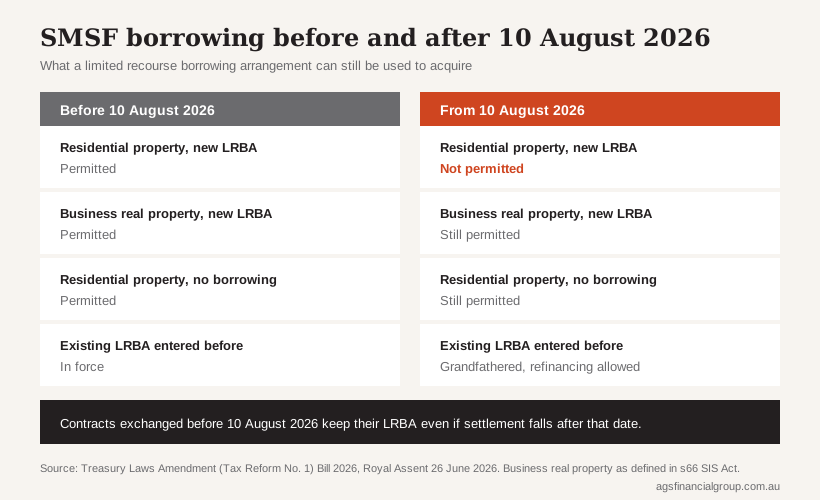
Three protections sit alongside it:
- Existing arrangements continue. An LRBA entered into before commencement is unaffected and runs to its natural end.
- Refinancing is allowed. Moving an existing LRBA to a different lender does not break the grandfathering. Given how thin SMSF lending has become, that matters for trustees on legacy rates.
- Exchange date is the trigger, not settlement. A contract exchanged on 9 August settling in November is still protected.
What an SMSF can still do
Four routes remain open.
- Buy residential property outright. A fund with the cash can still acquire residential property without borrowing. Every existing rule continues to apply, including the absolute prohibition on a member, a relative, or any related party living in it.
- Borrow for business real property. Offices, warehouses, factories, consulting rooms, and retail premises used wholly and exclusively in a business remain eligible for an LRBA, whether the tenant is the members’ own business or an unrelated one on a market lease.
- Borrow to acquire assets that aren’t real property. The restriction is written around real property, so an LRBA over a parcel of managed fund or ETF units is unaffected by it.
- Hold property it already owns. Nothing forces a sale.
What’s gone is the geared residential purchase, which for many funds was the whole reason the SMSF existed.
Commercial property is the main route
This is now the only borrowing route into real property inside super, and it suits more funds than trustees tend to assume.
The carve-out is defined by the property, not by the tenant. Business real property means premises used wholly and exclusively in one or more businesses, and whose business that is doesn’t matter. A fund can buy an office, warehouse, shop or consulting suite and lease it on the open market to a tenant it has no connection to, on ordinary commercial terms. Owning a business is not a prerequisite for using this route.
The unrelated-tenant version is the simpler one. There’s no related-party lease for an auditor to scrutinise, no in-house asset question, and the rent is set by the market rather than by a valuation the fund has to defend each year. In exchange the fund takes ordinary landlord risk: vacancy between tenants, incentives to fill space, and the quality of the covenant it signs.
Leasing back to your own business is the other route, and the one most business owners come for. The mechanics are unchanged. The fund acquires the premises, borrows through an LRBA with the asset held in a holding trust, and leases the property to the operating entity. The lease has to be genuine: written, at market rent, and paid on time. An auditor who finds a related-party tenant in arrears will report it, and the fund can be treated as having lent money to a member.
A fund with roughly $530,000 of member balances can support a purchase in the order of $800,000 with a loan around 65% of value, once acquisition costs and a cash buffer are allowed for. That leaves the fund holding the premises alongside a residual investment portfolio rather than concentrating everything in one asset. Those figures are illustrative and the workable numbers depend on the fund’s balance, its income, and what a lender will accept.
Concentration risk lands differently depending on who the tenant is. Any fund whose main asset is one property is exposed to that property. Where the tenant is also the members’ own business, the exposure doubles up: if the business struggles, the rent stops and the members’ income stops at the same time. An unrelated tenant breaks that correlation, which is a genuine argument for the open-market version even when leasing back is available.
Geared funds and geared ETFs
Where the objective is leverage rather than property specifically, internally geared funds and geared exchange traded funds achieve gearing without the fund itself borrowing. The gearing sits inside the investment, so no LRBA is involved and the ban is not engaged.
The practical difference between products is the loan-to-value ratio, which sets how far each dollar of member capital reaches:
| Internal LVR | Per $1 of member capital | Total market exposure | Comparable to |
|---|---|---|---|
| Around 65% | plus $2 borrowed | $3 | A typical LRBA |
| Around 50% | plus $1 borrowed | $2 | Moderate gearing |
| Around 33% | plus $0.50 borrowed | $1.50 | Conservative gearing |
Gearing amplifies losses on the way down exactly as it amplifies gains on the way up, and geared products can be forced to deleverage in a falling market, crystallising losses at the worst point. Several are classified as complex products for good reason. Whether any of them suits a particular fund depends on the fund’s investment strategy, its liquidity needs, and how close its members are to drawing a pension.
Borrowing from a member
An LRBA does not have to come from a bank, and the asset does not have to be property. Both points matter more now than they did before August.
A member can lend to their own fund under an LRBA, and the arrangement can be used to acquire a parcel of listed securities, an exchange traded fund among them, rather than real estate. The ban is written around real property, so a member-funded LRBA over listed units sits outside it. For a fund that wanted gearing rather than bricks, this is the structure that survives the change most cleanly, and it does so without depending on a lender that will write SMSF business.
The usual mechanics still apply. The units sit in a holding trust until the loan is repaid, the lender’s recourse is limited to that parcel, and one arrangement funds one acquirable asset. A parcel of identical units counts as a single acquirable asset. A mixed portfolio does not.
The loan has to charge market interest. A concessional related-party loan, and a nil-interest one above all, is what the non-arm’s length income rules exist to catch. Income taxed as NALI is taxed at 45%, and that reaches the geared asset’s income and its eventual capital gain, not just the interest the fund saved.
The ATO’s PCG 2016/5 sets out terms it will accept without further scrutiny. Where the borrowing is used to acquire listed shares or units in a listed unit trust, which is what an ETF is, the safe harbour requires:
- Interest at the RBA indicator rate for standard variable housing loans (investor), plus 2%, compounded monthly
- A loan-to-value ratio no higher than 50%
- A term no longer than seven years, or three years where the rate is fixed
- Principal and interest repayments under a written agreement, secured by a registered charge over the securities
That 50% cap is the real constraint. A member-funded LRBA over listed units inside the safe harbour reaches $2 of market exposure per $1 of member capital, not the $3 a 65% property LRBA reaches. Unlisted managed funds fall outside this safe harbour, so a loan to acquire them has to be evidenced as arm’s length on its own merits.
Where the asset is residential property acquired under a new arrangement, the ban applies regardless of who the lender is.
Buying jointly with your fund
A fund and a member can buy a property together as tenants in common, each holding a proportion outright. Because neither party lends to the other and the fund’s share is unencumbered, no LRBA exists and the restriction is not triggered.
An $800,000 property split evenly leaves the fund holding a $400,000 interest and the member holding the other half personally. The member can gear their own share outside super, where borrowing is unrestricted, while the fund’s half sits in the concessionally taxed environment.
This is legitimate and it’s also where care is needed. The ownership split must be documented and maintained, no money can move between the two parties in a way that resembles a loan, and if the property is residential the member still cannot live in it. Exit is the part trustees underestimate, because selling a half interest independently is difficult and the two owners have to agree on timing.
Negative gearing outside super
The other measure from the May budget affects strategy outside super. Negative gearing on established residential property ends from 1 July 2027 for properties bought after 7:30pm on 12 May 2026. Losses will be quarantined against rental income or future capital gains rather than offset against salary. Properties held at announcement are grandfathered, and eligible new builds are exempt.
Complying super funds, including SMSFs, are excluded from that measure.
For clients weighing where to put the next dollar, that shifts the comparison. Gearing against existing equity and recycling non-deductible debt into income-producing assets becomes relatively more attractive, which is why debt recycling has moved up the agenda in client conversations this year.
Where this leaves trustees
If your fund already holds a geared residential property, nothing changes. Keep the arrangement, and look at refinancing if your rate is a legacy one.
If your fund was set up specifically to buy residential property with borrowed money and hasn’t yet, that plan needs rebuilding. The realistic options are an unencumbered purchase, a commercial property if the strategy suits, gearing achieved inside the investments instead, or a joint purchase with the member. Each carries a different risk profile and none is a like-for-like replacement.
If you were mid-transaction in early August, check the exchange date on the contract. That single date determines which set of rules applies to you.
Talk to our SMSF team
The right answer here depends on the fund’s balance, its members’ ages, the business behind it if there is one, and how much concentration risk the members will accept. That’s a conversation rather than a checklist.
Our SMSF specialists work with trustees on fund strategy, LRBA structuring where it remains available, and the annual administration and audit that keeps arrangements clean, from our North Sydney office and nationally. Book a free initial discussion if you want to work through what the change means for your fund.