
Key points
- Earnings inside an SMSF are taxed at 15% in the accumulation phase and 0% in the retirement phase, up to the transfer balance cap.
- Capital gains on assets held longer than 12 months get a one-third discount, an effective 10% rate in accumulation.
- The concessional contributions cap is $32,500 for 2026-27, with unused amounts able to be carried forward if your total super balance is under $500,000.
- SMSFs can receive refundable franking credits, which can produce a cash refund in the pension phase.
- From 1 July 2026, Division 296 adds 15% on earnings on the portion of a balance between $3 million and $10 million, and 25% on the portion above $10 million.
An SMSF is taxed lightly by design. The question is whether the fund is run to capture that, or whether it pays more than it needs to because contributions land in the wrong year, assets are sold at the wrong time, or franking credits go unclaimed. The structure does the heavy lifting, but the timing decisions are the trustee’s. That’s where a fund gains or loses real money each year.
The rates that make the case
The reason super is tax-effective comes down to three rates, and every SMSF strategy works off them.
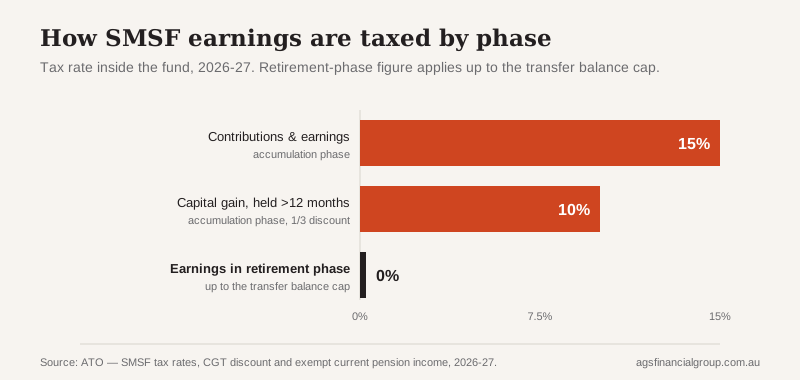
In the accumulation phase, the fund’s income and realised gains are taxed at 15%. That already sits below most members’ marginal rates. Move the fund, or part of it, into the retirement phase, and the earnings on those assets are not taxed at all, up to the transfer balance cap. The gap between 15% and 0% is the single biggest lever an SMSF has, and most of the strategies below are about deciding what income and which gains fall on the right side of it.
These rates apply to balances below the Division 296 threshold. Above $3 million, the extra tax covered further down stacks on top.
Contribution timing
Contributions are taxed and capped by financial year, so the year a contribution lands in matters as much as the amount.
- Concessional contributions are capped at $32,500 for 2026-27. These are the deductible ones: employer super, salary sacrifice and personal deductible contributions. They’re taxed at 15% going in, which suits anyone whose marginal rate is higher than that.
- Carry-forward of unused caps. If your total super balance was under $500,000 at the previous 30 June, you can use unused concessional cap amounts from the past five years. A member who sells an asset with a large gain can use several years of catch-up cap in one year to offset it.
- Non-concessional contributions are capped at $130,000 for 2026-27, or up to $390,000 under the bring-forward rule over three years. These go in after tax and aren’t taxed again inside the fund.
Getting a contribution in before 30 June, or deliberately holding it until 1 July to fall in the next year’s cap, is one of the most common and most overlooked pieces of SMSF planning.
The CGT discount and when you sell
An SMSF that holds an asset for more than 12 months before selling it gets a one-third CGT discount, which turns the 15% rate into an effective 10% on the gain. Selling an asset held for less than 12 months forgoes that, so the holding date is worth checking before any disposal.
The larger lever is the pension phase. A gain realised on an asset that’s supporting a retirement-phase pension can be exempt from tax entirely. For a member approaching retirement, the sequencing question is real: selling a large holding a year early, in accumulation, can cost 10% of the gain that would have been zero a year later in pension phase. That timing decision is exactly the kind of thing to plan with your fund’s administration and advice team rather than discover at tax time.
Franking credits
Australian shares that pay franked dividends carry franking credits for the tax already paid by the company at 30%. Because an SMSF is taxed at 15% or 0%, those credits are often worth more to the fund than the tax it owes.
- In the accumulation phase, franking credits offset the fund’s 15% tax bill and can reduce it substantially.
- In the retirement phase, where the fund pays no tax on that income, the credits are refundable. The fund can receive the franking credits back as cash.
For a retirement-phase SMSF weighted towards fully franked Australian shares, franking credit refunds can be a meaningful part of the annual return. It’s one of the clearest reasons trustees hold direct Australian equities inside the fund.
Division 296 and larger balances
From 1 July 2026, Division 296 applies an extra tax on the earnings tied to large balances. The portion of an individual’s total super balance between $3 million and $10 million carries an extra 15%, and the portion above $10 million an extra 25%. Both thresholds are indexed. It matters for SMSFs because these funds are more likely to hold large, illiquid assets like property, and the tax applies across a member’s whole super balance, not just the SMSF.
The tax is based on realised earnings. An earlier proposal to tax unrealised gains, the paper increase in value on assets you haven’t sold, was dropped before the legislation passed.
2026-27 is the transition year. Division 296 commenced on 1 July 2026, but a member’s balance is first measured for it on 30 June 2027, so this financial year is the window to plan before the first test applies. If a member’s balance is near or above $3 million, the questions to work through now are whether to hold certain assets inside super at all, how a balance is split between members, and how a tax bill that lands on the member personally will be funded. These are decisions to take with advice this year, not after the first assessment.
The catch
None of this is free. An SMSF carries a compliance load that an ordinary fund handles for you: an annual audit, market-value asset reporting, a documented investment strategy, and personal responsibility as trustee for every decision. Penalties for getting it wrong apply to the trustees personally. The tax advantages are real, but they only pay off on a balance large enough to justify the fixed costs and for a member willing to run the fund properly. We cover where that line sits in our guide to SMSF setup, costs and compliance.
Getting SMSF tax right
The tax rules reward funds that are managed with the year-end in view rather than reconstructed after it. Contribution timing, the 12-month CGT line, franking credit positioning and the move into pension phase all have to be decided before the events happen, not lodged after. AGS administers more than 500 funds, so this planning runs to a known annual cycle. For trustees in the lower North Shore, our North Sydney SMSF team handles the strategy and the compliance together, and the same service runs across all eight offices.
If you want your fund’s tax position reviewed before this financial year closes, book a free initial discussion with the AGS SMSF team.