Key points
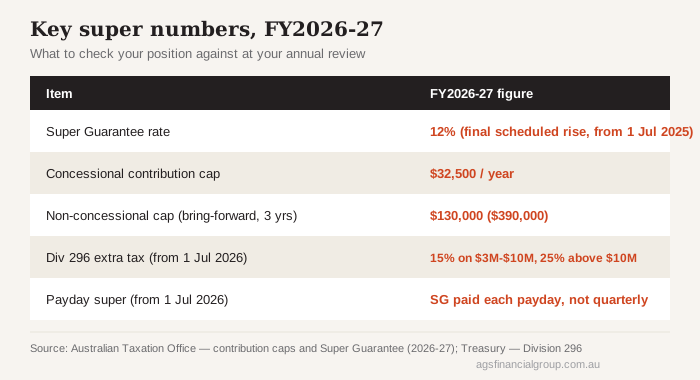
- The Super Guarantee rate is 12% of ordinary earnings, its final scheduled increase, in place since 1 July 2025.
- The concessional (before-tax) contribution cap rose to $32,500 for FY2026-27; the non-concessional cap rose to $130,000.
- Div 296 adds an extra 15% tax on earnings for the portion of a super balance between $3 million and $10 million, and an extra 25% on the portion above $10 million, from 1 July 2026.
- The ATO’s own data shows billions of dollars in “lost” and unclaimed super sitting in the wrong accounts.
Most people set up a super fund once, usually whichever one their first employer nominated, and never look at it again. Balances grow through compulsory contributions regardless, so it’s easy to assume everything is taking care of itself. It usually isn’t. A super health check is a short annual review that catches the fee leaks, insurance gaps and stray accounts that cost people tens of thousands of dollars by the time they retire.
1. Check for multiple accounts
Every job change is an opportunity to accidentally open a new super account, especially before an employer’s default fund was linked to your existing one. Each extra account means an extra set of administration fees and, in many cases, an extra insurance premium being deducted from a balance you’re not actively using. Consolidating into one fund removes the duplicate fees immediately, though it’s worth checking insurance cover in the old fund before closing it. Cancelling a policy you’d struggle to replace at your current age or health is the most common consolidation mistake.
2. Check what you’re paying in fees
Super fees are usually charged as a percentage of your balance plus a flat administration fee, and they vary more between funds than most members expect. On a $200,000 balance, the difference between a 0.5% and a 1.5% total fee is $2,000 a year, compounding over decades. Your annual statement shows the fee breakdown. It’s worth comparing it against at least one other fund’s published fee schedule to see where you sit.
3. Check your investment option matches your timeframe
Most funds default new members into a “balanced” or lifecycle option. That’s a reasonable starting point, but it isn’t automatically right for everyone. Someone in their 30s with decades until retirement is often paying for more caution than they need. A lifecycle option carries the opposite risk later on. It de-risks members automatically as they age, which can leave someone in their 60s too conservatively invested for money that still has to work for another two or three decades of retirement. Someone in a single fixed option a few years out from retiring may instead be carrying more growth-asset risk than they realise. Match the option to your actual timeframe and risk tolerance, rather than leaving it on the default.
4. Check your insurance inside super
Most funds provide default life, total and permanent disability, and income protection cover automatically. That default cover is convenient, but it’s rarely tailored to your circumstances. It’s worth checking the sum insured against what your family would actually need, whether the definitions suit your occupation, and whether premiums are eroding a balance that’s otherwise too low to justify the cost, which is a particular issue for younger members and those with multiple accounts.
5. Check your beneficiary nomination is current and binding
Superannuation doesn’t automatically form part of your estate, so a will doesn’t control where it goes. That’s determined by your beneficiary nomination with the fund. A non-binding nomination is only a guide for the trustee. A binding nomination, kept current and renewed every three years for most funds, gives certainty. Nominations left over from a previous relationship or naming an adult child who’s no longer a dependant are among the most common problems we see when reviewing a new client’s super.
6. Check you’re using your contribution caps well
The concessional cap is $32,500 a year for FY2026-27, covering employer contributions, salary sacrifice and personal deductible contributions combined. The non-concessional cap is $130,000, with a bring-forward rule allowing up to $390,000 over three years for eligible members. Unused concessional cap amounts can be carried forward for five years for those with a total super balance under $500,000, which is a useful tool for anyone who’s had an irregular income or is catching up later in their career.
Why this is worth doing annually, not once
Rules change most years. The Super Guarantee rate reached 12% on 1 July 2025, its final scheduled increase, and payday super has applied since 1 July 2026, changing how often employers must pay contributions. From the same date, Div 296 adds an extra tax on the earnings behind large balances: 15% on the portion between $3 million and $10 million, and 25% above $10 million. The contribution caps rose on 1 July 2026 too. None of these change what individual members should do on their own, but they shift the numbers a review is measured against, which is why an annual check matters more than a one-off setup.
At AGS, a super health check is a standard part of an annual review with clients, alongside the broader retirement and investment conversation. If yours hasn’t been looked at in a while, book a conversation with one of our advisers.