
Key points
- A defined benefit pays a lump sum or a pension set by a formula, not by an account balance or investment returns.
- The formulae are often generous, because they were built on inflation and investment-return assumptions that ran higher than what followed.
- The defined benefit income cap for 2026-27 is $131,250, being the $2.1 million general transfer balance cap divided by 16 (ATO).
- Above that cap, taxed-source pensions have 50% of the excess added to assessable income, and untaxed-source pensions lose the 10% tax offset.
- A defined benefit pension counts toward the transfer balance cap at 16 times its annual amount.
- Most Australian defined benefit schemes are closed: CSS closed to new members on 30 June 1990, PSS on 30 June 2005, MilitarySuper in 2016.
Nearly every conversation about superannuation in Australia assumes an account balance. How much have you got, what’s it invested in, how long will it last. For defined benefit members none of those questions apply in the usual way, and advisers who work mostly with accumulation clients often carry accumulation assumptions into a situation where they don’t hold.
The distinction matters because defined benefit members are frequently the people with the most at stake. Long-tenure public servants, academics, police, defence personnel and career corporate employees hold entitlements that can be worth well over a million dollars once valued properly, governed by scheme rules written decades ago.
How a defined benefit works
An accumulation fund is a bucket. Contributions go in, investment returns are added or subtracted, fees come out, and whatever is left is yours. You carry the investment risk.
A defined benefit is a promise. The scheme calculates what it owes you using a formula, typically some version of:
Final or final-average salary × years of service × an accrual rate set by the scheme.
What comes out the other end is a lump sum, a pension, or in many schemes a choice between the two. CSS and PSS members, for example, can take part of the benefit as a lump sum and convert the rest to a pension. Some schemes pay a lump sum only. The formula sets the size of the entitlement; the scheme rules set the form it can be taken in.
Market returns don’t change that number. A person who retires after a bad year on the sharemarket receives the same entitlement as one who retires after a good year, because the employer or the scheme carries the investment risk instead of the member.
Why these schemes are generous
Defined benefit entitlements are frequently worth more than members assume, and the reason is in the age of the formulae.
Accrual rates and conversion factors were set decades ago, using assumptions about inflation and long-run investment returns that were higher than what the following decades delivered. The promise stayed fixed while the cost of funding it rose. A scheme committed to paying a CPI-indexed pension for life, priced when bond yields and expected returns sat well above where they later settled, becomes an expensive obligation for the sponsoring employer or government.
That is the main reason these schemes closed to new members, one after another, from 1990 onwards. It is also why a defined benefit entitlement is usually worth holding onto and worth understanding properly. The terms available to an existing member are generally better than anything they could buy in the open market today.
What members see on a statement is often a notional balance or a multiple, which is not the same thing as the entitlement’s real value. Working out what a defined benefit is genuinely worth requires the scheme rules, not the statement headline.
Which funds are defined benefit
Almost all Australian defined benefit schemes are closed to new members. If you are in one, you have generally been in it a long time.
| Scheme | Status |
|---|---|
| CSS (Commonwealth Superannuation Scheme) | Closed to new members 30 June 1990 |
| PSS (Public Sector Superannuation Scheme) | Closed to new members 30 June 2005 |
| MilitarySuper (MSBS) | Closed to new members 2016 |
| State Super NSW (SASS, SSS, Police) | Closed to new members late 1980s to early 1990s |
| Large corporate plans | Mostly closed divisions inside bigger funds. See below |
| UniSuper Defined Benefit Division | Still open to eligible university and research staff |
Several state schemes in Victoria, Queensland, Western Australia and South Australia follow the same pattern. The UniSuper DBD is one of the few still accepting new members, and only for staff at participating institutions.
The corporate side is where most people lose track of their entitlement. Australia Post, the Westpac Group Plan, Commonwealth Bank Group Super and the Reserve Bank’s own scheme all ran defined benefit divisions, as did a long list of banks, miners, insurers and utilities. Almost all closed to new members through the 1990s and 2000s, then kept paying existing members.
Consolidation has made them harder to follow. TelstraSuper merged into Aware Super on 30 April 2026, and Qantas Super contributions moved to Australian Retirement Trust from March 2025. A closed defined benefit division does not disappear in a merger, it transfers, but the branding on the annual statement changes and members sometimes assume the entitlement was converted to an ordinary account balance. It generally wasn’t. Anyone who worked at a large employer through the 1980s or 1990s is worth checking for a preserved defined benefit interest, even if their statement now carries a different fund’s name. Working out how a preserved defined benefit interest fits the rest of your retirement is one of the questions that sits outside a fund’s own advice, and it is where comprehensive advice for super fund members comes in.
A scheme’s category also determines its tax treatment, which is where most of the complexity sits.
Taxed source and untaxed source
This is the distinction that catches people, including many advisers.
Taxed-source schemes paid tax on contributions and earnings along the way, in the ordinary manner. Most corporate defined benefit funds and the UniSuper DBD sit here.
Untaxed-source schemes did not. The large unfunded government schemes, CSS, PSS and State Super among them, pay pensions from consolidated revenue rather than from an invested pool, and the tax is collected at the other end, from the member.
The practical consequence is that two people with identical $120,000 pensions can have very different after-tax incomes. Someone drawing from a taxed source at age 62 receives it tax free. Someone drawing the same amount from PSS pays marginal rates on it, reduced by a 10% offset.
The $131,250 cap
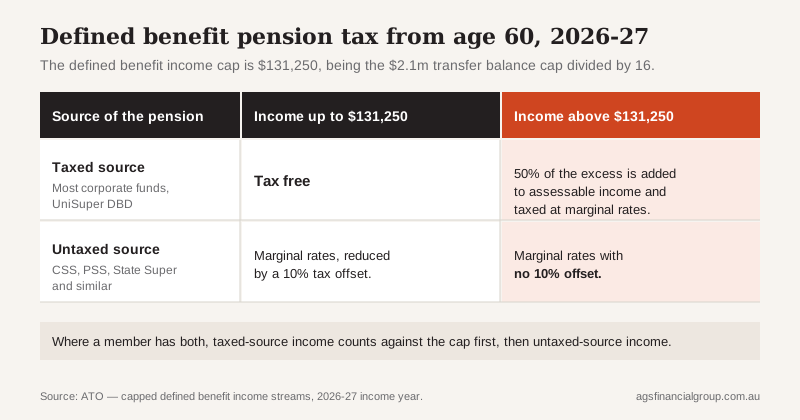
The defined benefit income cap for 2026-27 is $131,250, calculated as the $2.1 million general transfer balance cap divided by 16. The general cap rose from $2 million on 1 July 2026, which lifted the defined benefit figure from $125,000.
Above that threshold the treatment changes:
- Taxed source. Half of the amount above the cap is added to assessable income and taxed at marginal rates. Below the cap it stays tax free.
- Untaxed source. The 10% tax offset applies only to income up to the cap. Anything above it is taxed at full marginal rates with no offset.
- Both. Where a member receives income from a taxed and an untaxed source, the taxed-source income is counted against the cap first.
For a senior public servant or academic with a long service history, crossing $131,250 is realistic rather than theoretical, and the marginal cost of the income just above the line is higher than most people expect.
Contribution caps work differently too
Defined benefit members don’t have a simple employer contribution figure. Instead the fund calculates a notional taxed contribution, an estimate of what an equivalent accumulation contribution would have been, and that notional amount counts toward the concessional contributions cap.
Two things follow. Your reported concessional contributions may bear little resemblance to anything on your payslip, and the room left for salary sacrifice or personal deductible contributions can be much smaller than a colleague on the same salary in an accumulation fund. Members who assume they have the full concessional cap available sometimes breach it without realising.
Grandfathering exists. Where a defined benefit interest was established before 12 May 2009 and the notional contributions exceed the cap, the fund may treat them as equal to the cap instead. It doesn’t apply to constitutionally protected funds or to unfunded interests, and it is the fund’s job to determine and report eligibility, not the member’s. Anyone running close to the cap is better off checking the reported figure each year than reconstructing it from payslips, and our superannuation advice team does this as part of an annual review.
The decision that can’t be undone
At retirement or resignation, many schemes offer a choice: take a lifetime indexed pension, take a lump sum, or take some combination. Where that choice exists it is generally irreversible.
The pension side offers income that continues for life and usually indexes with inflation, removing both longevity risk and market risk. That is a genuinely valuable combination, and it is difficult to replicate by buying an equivalent product on the open market.
The trade-offs are real and run the other way:
- No flexibility. A pension cannot be drawn down faster in a year when you need capital for a house, health costs or helping family.
- Limited estate value. The capital does not sit in an account that passes to beneficiaries.
- Indexation varies. Some schemes index to CPI, some to a wage measure, some at a fixed rate, and the difference compounds substantially over a 30-year retirement.
- Interaction with other income. A large pension consumes the defined benefit income cap and affects Age Pension means testing and the tax on other investments.
Which side wins depends on health and life expectancy, whether there is a spouse and their age, other assets held outside super, and whether there is a specific need for capital. That mix differs enough between two people on identical salaries that a general answer is worth very little.
What happens when you die
Defined benefit death benefits work differently from accumulation, and this is the part that surprises families most.
Most schemes pay a reversionary pension to an eligible spouse at a reduced percentage set by the scheme rules, commonly around two thirds, though it varies. Some require the relationship to have existed before retirement. Where there is no eligible spouse, the pension may reduce sharply or stop, with only a limited residual payable.
A defined benefit pension generally cannot be left to adult children, and a binding death benefit nomination does not direct it the way it directs an accumulation balance. For a couple whose main retirement asset is a defined benefit pension, that changes the whole estate planning picture, and it is worth confirming the scheme’s specific rules rather than assuming the general pattern applies.
Start well before you retire
The decisions that determine what a defined benefit is finally worth are made in the years before retirement, not on the day of it. By the time the election form arrives, most of the variables are already locked.
Several of them respond to planning with enough lead time:
- Final average salary. Most formulae use salary averaged over the last few years of service, so a shift to part-time hours, a step back from a senior role, or the timing of a promotion late in a career feeds directly into the entitlement.
- Member contribution rates. Some schemes let members vary their own contribution rate, and in several the rate chosen affects the final multiple. Changing it in the last year does little; changing it years out does more.
- How you leave. Resignation, retirement, redundancy and reaching a scheme’s own retirement age can produce materially different entitlements from the same fund.
- The order things happen in. The defined benefit income cap, the transfer balance cap and any accumulation balances interact, and the sequence in which benefits start affects the tax on all of them.
- The election itself. Pension, lump sum or a combination is generally irreversible once lodged.
None of that is guesswork, but none of it is on the annual statement either. It requires the scheme’s governing rules, and schemes that sound alike routinely differ on exactly these points.
This is the case for working with someone who has seen these schemes before. Defined benefit funds are a small and shrinking part of the superannuation system, so many advisers encounter them rarely and apply accumulation logic by default. Our retirement planning team works through defined benefit entitlements alongside the rest of a client’s position, including for members of the closed government schemes and for staff covered by corporate superannuation arrangements, across all six AGS offices.
If retirement is somewhere in the next five to ten years and a defined benefit sits in the picture, that is the point at which modelling changes what is available, rather than just explaining what has already been decided. A free initial discussion is the place to start.
Frequently asked questions
What is defined benefit superannuation? A defined benefit fund pays a lump sum or a pension calculated by a formula, usually based on your final or final-average salary, your years of service and an accrual rate set by the scheme. The amount does not depend on investment returns or on an account balance, which is the opposite of how an accumulation fund works. The formulae are often generous, because they were set using inflation and investment-return assumptions that proved higher than what followed.
Is a defined benefit pension tax free after 60? Only if it comes from a taxed source. Pensions from taxed-source schemes are tax free from age 60 up to the defined benefit income cap, which is $131,250 in 2026-27. Pensions from untaxed-source schemes such as CSS, PSS and State Super are taxed at marginal rates with a 10% tax offset, and that offset is lost on income above the cap.
Can I take my defined benefit as a lump sum instead of a pension? It depends on the scheme. Some allow a full lump sum, some allow a partial commutation, and some pay a pension that cannot be converted at all. Where a choice exists it is usually irreversible once made, so it is worth modelling both options against your circumstances before electing.
What happens to a defined benefit pension when you die? Most schemes pay a reduced reversionary pension to an eligible spouse, at a percentage set by the scheme rules. Unlike an accumulation balance, a defined benefit pension generally cannot be left to adult children or directed by a binding death benefit nomination, so it usually falls outside what your estate can distribute.
Figures in this article are current for the 2026-27 income year and come from the ATO. Scheme rules vary, and the treatment of any particular entitlement depends on the fund’s own governing rules and on individual circumstances.