
Key points
- An investment bond pays tax on its own earnings at the 30% company rate, so nothing appears in your tax return while you hold it.
- Hold for ten years and withdraw, and the proceeds are tax-free with nothing to declare.
- Withdraw earlier and the growth is assessable, with a 30% offset. Two-thirds counts in year nine, one-third in year ten.
- Contribute up to 125% of last year’s amount each year without restarting the ten-year clock.
- No contribution caps and no preservation age, which is where they differ from super.
- Division 296 now taxes super earnings above $3 million at up to 30%, the same rate a bond pays.
- The 50% CGT discount is legislated to end on 1 July 2027, replaced by indexation and a 30% minimum tax.
- The Budget’s proposed 30% tax on discretionary trust distributions from 1 July 2028 puts bonds and family trusts in direct comparison.
Investment bonds have been available in Australia for decades and rarely come up in a first advice conversation. They sit in an odd position, technically a life insurance policy, practically a managed investment, and taxed like neither shares nor super. That structure is the whole point.
Three separate changes have moved them up the list. Division 296 is law and taxes super earnings above a $3 million balance at up to 30%. The removal of the 50% CGT discount is also now law, applying from 1 July 2027. And the 2026-27 Budget proposes a 30% minimum tax on discretionary trust distributions from 1 July 2028, which is announced but not yet legislated. Each one erodes an advantage a competing structure used to hold over a bond.
What an investment bond is
An investment bond is a managed investment issued by a life company. You choose from a menu of investment options, from conservative through to growth, in much the way you would with a managed fund or a super investment menu.
The difference is who pays the tax. The bond pays tax on its own earnings, at the 30% company rate, before anything is credited to your holding. You receive no annual distribution, report no income, and lodge nothing. Your tax return doesn’t know the bond exists.
The internal rate is fixed at 30% whatever your own rate is, so the whole question is how your marginal rate compares:
| Your marginal rate (incl. Medicare) | Against a bond’s 30% |
|---|---|
| 47% (income above $190,000) | Clear advantage |
| 39% (above $135,000) | Clear advantage |
| 32% (above $45,000) | Roughly neutral |
| 18% (above $18,200) | Works against you |
Below 30% you can’t claim back the difference, so the bond is taxing your earnings harder than you would be. That’s the single biggest reason a bond is the wrong answer for a lot of people, and it should be settled before anything else.
Bracket creep is the reason to think about this over the full ten years rather than today. Income tax thresholds aren’t indexed, and the government’s own forecasts rely on bracket creep to return the Budget to structural balance by 2035-36. Someone at 32% today may sit at 39% well before a ten-year bond matures.
The ten-year rule
The headline feature is what happens at ten years. Hold the bond for a full ten years, then withdraw, and the proceeds come to you tax-free with nothing to declare.
Withdraw earlier and the growth becomes assessable income, though you receive a 30% offset recognising the tax the bond has already paid. How much of the growth counts depends on when you withdraw:
| When you withdraw | Growth that is assessable |
|---|---|
| Years 1 to 8 | All of it, with a 30% offset |
| Year 9 | Two-thirds, with a 30% offset |
| Year 10 | One-third, with a 30% offset |
| After 10 years | None |
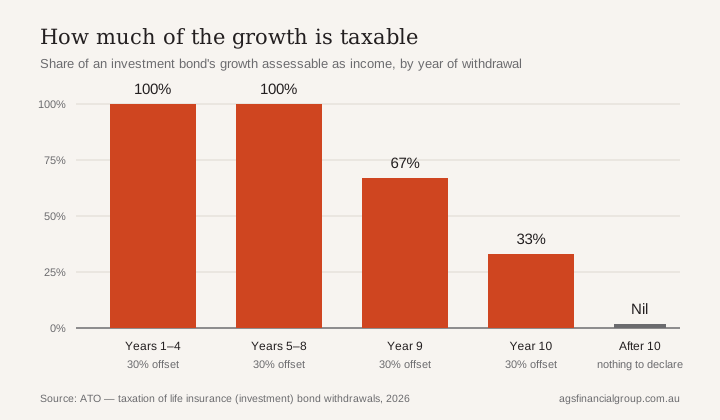
The tapering matters for planning. A bond started when a child is eight is available for university at eighteen with no tax to pay, which is why education is such a common use.
The 125% rule
The ten-year clock doesn’t force you to invest everything up front. You can keep adding, and each year you may contribute up to 125% of what you contributed the year before while keeping the original start date.
Put in $10,000 in year one and you can put in up to $12,500 in year two, then up to $15,625 in year three, and so on. All of it matures on the original date.
Two things reset the clock, and both catch people out. Contributing more than 125% of the previous year’s amount restarts the ten years from the start of that investment year. So does skipping a year entirely, because a contribution after a nil year starts a fresh ten-year period.
One detail makes this harder to track than it sounds. The year is measured on the bond’s own anniversary date, not the financial year, so a contribution that looks compliant across two financial years can breach the 125% test on the bond’s calendar. If you’re using a bond as a savings vehicle, set the contribution pattern deliberately and confirm the maturity date with the issuer rather than counting ten years from when you opened it. Getting this wrong doesn’t cost you the bond, but it can push the tax-free date years further out than you planned.
Where they fit against super
Super wins on tax. Earnings inside super are taxed at 15% in accumulation phase, against 30% inside a bond, and concessional contributions come out of pre-tax income. For most people building retirement wealth, superannuation is the first call and the bond question doesn’t arise.
Bonds earn their place at the edges of what super can do:
- The caps are full. Concessional and non-concessional contributions are both capped. A bond has no contribution limit at all.
- You need the money before preservation age. Super is locked until you meet a condition of release. A bond can be accessed at any time, with the tax consequence above.
- The balance is already large. Above $3 million the rate comparison has flipped, as the table below sets out.
- You want to direct the asset outside your will. More on that below.
Division 296 removed super’s rate advantage above $3m
Division 296 is law and commenced 1 July 2026. It adds 15% on super earnings attributable to a balance above $3 million, and 25% above $10 million. Both thresholds are indexed.
| Super balance | Tax on earnings | Against a bond’s 30% |
|---|---|---|
| Under $3 million | Up to 15% | Super wins clearly |
| $3 million to $10 million | Up to 30% | Level |
| Above $10 million | Up to 40% | Bond is lower |
Above $3 million, a dollar of super earnings and a dollar of bond earnings are taxed at the same rate. Super still has the better contribution treatment, so this isn’t an argument for pulling money out. It does mean that for the next dollar, once the caps are used, super has stopped offering a rate advantage while keeping its access restrictions. Above $10 million the bond is the lower-taxed structure outright.
Against a family trust
Discretionary trusts have done a job bonds couldn’t: stream income to whichever family member sits in the lowest bracket that year. The Budget proposes to end that.
Proposed from 1 July 2028, a 30% minimum tax applies to discretionary trust distributions, with a non-refundable offset credit for beneficiaries other than corporate ones. The point of the measure is to remove the benefit of flexible income streaming to lower-earning family members. There’s proposed rollover relief for three years from 1 July 2027 for anyone wanting to restructure out of a discretionary trust.
If that lands as announced, a trust distributing to adults faces a 30% floor while a bond pays up to 30%, so the rate gap closes and the trust keeps its annual compliance load. Trusts still do things a bond can’t, including holding operating business assets and giving genuine discretion over who receives what. For purely passive investments, the tax arbitrage that justified the complexity largely goes.
Two points matter if you already have a trust.
A trust can own an investment bond. Because a bond doesn’t distribute income, a trust holding one has no distributable income from it in a year with no withdrawal, which removes the annual distribution decision without winding anything up. And moving a trust’s investments into a bond doesn’t trigger a distribution to beneficiaries, though switching the underlying assets to fund it will have its own CGT consequences.
Transferring a bond’s ownership from the trust to a beneficiary generally doesn’t trigger a CGT event, because specific exemption rules apply to bond ownership transfers. An in-specie transfer of most other assets out of a trust is a disposal and does trigger one.
What the CGT changes mean
The other change that matters here is capital gains tax, and this one is law rather than a proposal.
From 1 July 2027, the 50% CGT discount is replaced with cost base indexation plus a 30% minimum tax rate on capital gains, for assets held by individuals, trusts and partnerships. That covers shares, property and managed funds. Pre-1985 assets are brought in, subject to carve-outs. Gains accruing before 1 July 2027 keep the current treatment, which will mean establishing market values at that date.
Super funds keep the existing one-third discount. That asymmetry is the crux: personally held investments outside super carry the most exposure to the change, and they’re exactly the holdings a bond competes with.
A bond has no personal CGT event at all. Switching between investment options inside it isn’t a disposal for you, and after ten years the withdrawal isn’t either. Against a structure where every rebalance and every sale becomes a calculation under new and more complex rules, that simplicity counts for more than the headline rate suggests.
The two carry different weight. The CGT change is legislated, so 1 July 2027 is a date to plan around. The trust measure is an announcement, still subject to consultation and amendment, and the enacted version may differ from what was flagged. Restructuring a trust on the strength of an announcement carries its own risk.
Estate planning uses
A bond lets you nominate beneficiaries directly. On your death the proceeds are paid to those people, tax-free, without passing through your estate. That means no wait for probate and no exposure to a claim against the will.
For blended families, that’s the feature that matters most. It gives you a way to leave a defined amount to a specific person with far less scope for dispute than a bequest in a will. It works alongside your estate plan rather than replacing it, and the nomination needs checking whenever your circumstances change.
There’s also a child advancement option, where the bond transfers to a child at an age you set. The transfer isn’t a capital gains event, so the asset changes hands without triggering tax. That exemption applies to bond ownership transfers generally, not only to a child, which is what makes a bond portable between generations in a way most assets aren’t.
Set that against how super is treated on death. A super death benefit paid to a non-dependant, an adult child in most cases, attracts 15% tax on the taxable component. Division 296 has made super a less attractive place to hold wealth intended for the next generation, and the Treasurer has explicitly ruled out an inheritance tax, so the 15% on adult-child death benefits is the comparison that stands. A bond paid to a nominated beneficiary carries no tax at all.
Bonds can also offer protection from creditors in a bankruptcy, covering the bond and proceeds received on or after the date of bankruptcy. That depends on being structured correctly, so treat it as something to set up deliberately rather than a feature you get by default.
What to watch
Bonds aren’t a universal answer. The 30% internal rate is a real cost if your marginal rate is lower, and you give up the ability to time a disposal into a low-income year or to use capital losses in your own return. The investment menu is set by the issuer, so you get their options rather than the whole market. Fees vary between issuers and deserve comparing properly, because a fee difference compounds over a ten-year hold.
The 30% figure is a ceiling rather than a fixed charge. How much tax a bond actually pays depends on the issuer’s tax management and on the mix of income and franking credits in the underlying options, so the effective rate over a long hold can land below 30%. Issuers publish their own estimates and those estimates aren’t guarantees, which makes it a question to ask about specifically rather than assume.
And the ten-year rule rewards patience. If there’s a real chance you’ll need the money in year four, the early-withdrawal treatment removes much of the reason to use a bond in the first place.
Getting the structure right
Whether a bond belongs in your plan depends on your marginal rate, how much super headroom you have left, when you need access, and who you want to end up with the money. Those are four different questions and they don’t always point the same way.
AGS brings financial planning, wealth creation and estate planning together, so a decision about structure gets tested against your tax position and your estate intentions at the same time rather than in isolation. Contact us to talk through where the next dollar should go.
Frequently asked questions
What is an investment bond? A managed investment issued by a life company. Legally it’s a life insurance policy, which is what gives it its tax treatment. The bond pays tax on its own earnings at the 30% company rate, so nothing appears in your tax return while you hold it, and you can choose the underlying investment options much as you would in a managed fund.
How does the 10-year rule work? Hold the bond for ten years and withdraw, and the proceeds are tax-free in your hands with nothing to declare. Withdraw earlier and the growth is assessable, though a 30% offset recognises the tax the bond has already paid. In the ninth year two-thirds of the growth is assessable, in the tenth year one-third, and after ten years none of it is. Note that the ten years does not always run from the date you opened the bond, because certain contribution patterns reset it.
What resets an investment bond’s 10-year clock? Two things, and both are easy to trigger by accident. Contributing more than 125% of the previous year’s contribution restarts the ten years from the start of that investment year. Making no contribution in a year also resets it, because a contribution in any later year begins a fresh ten-year period. The year is measured on the bond’s own anniversary date rather than the financial year, so check the maturity date with the issuer instead of counting from when you opened it. A bond you have held for eight years can have a tax-free date further away than you expect.
Are investment bonds better than super? They do a different job. Super is more tax-effective, at 15% on earnings in accumulation, so it comes first for most people. Bonds matter once the contribution caps are full, or when you need access before preservation age, because they have no caps and no age restrictions.
Are investment bonds an alternative to a family trust? They’re becoming a closer comparison. The Budget proposes a 30% minimum tax on discretionary trust distributions from 1 July 2028, which removes much of the benefit of streaming income to lower-earning family members. A bond pays up to 30% with no annual distribution decision and no yearly compliance. Trusts still do things a bond can’t, including holding business assets and giving real discretion over who receives what, so this is a comparison rather than a replacement. The measure is an announcement and may change before it becomes law.
How do the 2026-27 Budget CGT changes affect investment bonds? This one is law rather than a proposal. From 1 July 2027 the 50% CGT discount is replaced with cost base indexation and a 30% minimum tax rate on capital gains for assets held by individuals, trusts and partnerships, while super funds keep the existing one-third discount. A bond has no personal CGT event, so personally held shares and managed funds carry an exposure a bond avoids.
Who are investment bonds best suited to? People on a marginal rate above 30% who have used their super caps, grandparents or parents saving for a child’s education, and anyone who wants an asset to pass to a named beneficiary outside their will. If your marginal rate is below 30% the internal tax rate works against you.