
Key points
- A UK pension can only move to a Qualifying Recognised Overseas Pension Scheme (QROPS), which in Australia almost always means an SMSF.
- The UK’s 25% Overseas Transfer Charge is generally switched off when you and the QROPS are both in Australia, provided you stay put for five full UK tax years.
- Australia taxes the growth your UK fund made since you became a resident, the “applicable fund earnings”, unless you transfer within six months of arriving.
- The transfer counts as a non-concessional contribution, so it is capped at $130,000 a year or $390,000 under the three-year bring-forward rule.
- Moving a defined benefit pension means giving up a guaranteed income, and over £30,000 it needs UK-regulated advice before anyone will action it.
People who built a career in the UK and then settled in Australia often arrive with a pension still sitting in a scheme in Britain. The question of whether to bring it across comes up every time they look at their retirement, and the answer is rarely a quick yes or no. The transfer itself is one of the more technical moves in retirement planning, with rules on both sides of the world that have to line up before it works.
This is an explainer, not a recommendation. AGS is not a UK-regulated pension transfer specialist, and the decision to move a UK pension needs advice from a provider authorised in the United Kingdom as well as the Australian picture, which is the side our overseas-pension planning covers. What follows is how the mechanics work, so the conversation you have with that specialist starts from an informed place.
What a QROPS actually is
A UK pension cannot be paid straight into an ordinary Australian super account. HMRC only allows a transfer to a Qualifying Recognised Overseas Pension Scheme, a fund that appears on its published ROPS list and meets its conditions. One of those conditions is that the scheme must not release benefits before age 55.
Most Australian retail and industry super funds lost their QROPS status in 2015, when a UK rule change clashed with Australia’s rule allowing early access on compassionate and severe-hardship grounds. The practical result is that a self-managed super fund is the usual vehicle, set up so its trust deed restricts members to age 55 and over and meets the QROPS conditions. A small number of specialist public funds remain registered, but for most people the route runs through an SMSF built for the purpose.
The 25% charge, and when it switches off
The number that worries people is the Overseas Transfer Charge: a 25% UK tax on transfers to a QROPS. It does not always apply. The main exclusion covers people who are resident in the same country as the receiving scheme. An Australian resident moving a UK pension into an Australian QROPS sits inside that exclusion, so the 25% is generally switched off.
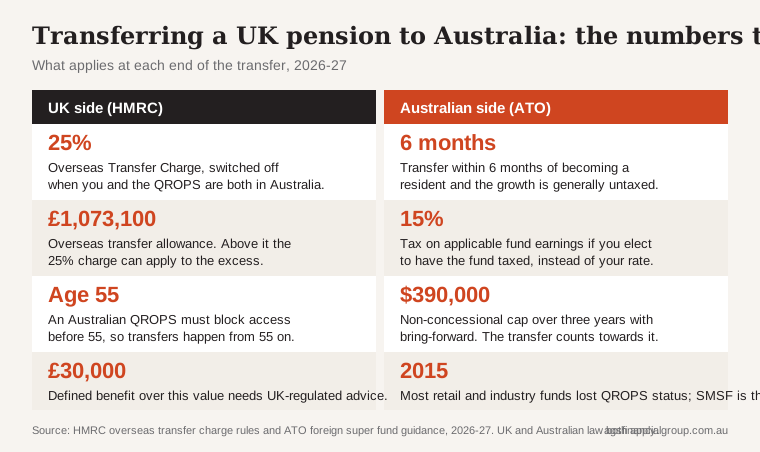
Two conditions sit under that exclusion. The amount needs to fall within the overseas transfer allowance of £1,073,100, above which the charge can apply to the excess. And the exemption is conditional for five full UK tax years after the transfer. If you move to a country that would not have qualified within that window, HMRC can apply the 25% retrospectively. Someone who transfers and then leaves Australia a couple of years later can find the charge comes back.
How Australia taxes the money coming in
The Australian side has its own tax, and it catches people who focus only on the UK charge. Australia taxes the growth your UK fund earned from the day you became a tax resident to the day it transfers. That growth is the “applicable fund earnings”, and it is taxable here.
There are two ways it is handled. By default the applicable fund earnings are added to your assessable income and taxed at your marginal rate. You can instead elect, under the foreign super fund rules, to have that amount taxed inside the receiving fund at 15%. For anyone on a marginal rate above 15%, the election usually wins, and it is one of the first things a tax adviser will model.
One timing rule removes the issue entirely. Transfer within six months of becoming an Australian resident and there are generally no applicable fund earnings to tax, because the clock has barely started. Most people who have been here for years are well past that window, which is why the applicable-fund-earnings calculation matters so much.
The contribution cap trap
The part of the transfer that is not applicable fund earnings lands in your super as a non-concessional contribution. That puts it under the non-concessional caps: $130,000 in a single year, or $390,000 brought forward across three years. A UK pension worth more than $390,000 cannot come across in one hit without an excess-contributions problem.
The usual answer is to stage the transfer across more than one financial year, or to pair it with other planning so the caps are used deliberately rather than breached by accident. A UK scheme sitting near or above the bring-forward cap needs the timing worked out before the first pound moves, not after.
Defined benefit is a different decision
Everything above assumes a defined contribution pot, a pension worth whatever the investments are worth. A defined benefit scheme is a different question, because it promises an income for life rather than a balance. Transferring it means giving up that guarantee for a transfer value, and the guarantee is often worth more than the number on offer.
The UK treats this seriously. A defined benefit transfer worth more than £30,000 cannot proceed unless you have taken advice from a UK-regulated pension transfer specialist, and many will advise against giving up a secure income. This is the clearest case where the transfer decision belongs with a UK-authorised adviser, not with an Australian plan alone.
Where the decision gets made
Transferring a UK pension to Australia brings three questions together: whether the UK charge applies, how Australia taxes the growth and the contribution, and whether what you would give up is worth what you would gain. They do not sit with one person. The transfer itself needs a UK-regulated specialist, because that is who can advise on the UK scheme and action the move. The Australian side, the applicable-fund-earnings election, the contribution-cap staging, the SMSF that receives the money and how it fits the rest of your retirement plan, is where AGS works.
Our accounting team handles the Australian tax on the transfer, and the financial planning team factors the UK money into the broader plan alongside your Australian super and any other overseas accounts. For the wider picture on foreign pensions and how Australian residency changes their tax, see our guide to overseas pensions and Australian tax, and for the State Pension and National Insurance years specifically, our guide to UK State Pension entitlements. If you have a UK pension and you are not sure whether moving it is right for you, a free initial discussion is the place to start, and you do not have to decide anything on the day.
Rules and thresholds in this article are current for the 2026-27 year and draw on HMRC overseas transfer charge rules and ATO foreign super fund guidance. Both UK and Australian law apply to a transfer, and both change.