
— Free 30-minute discussion
Weighing up a resident agreement?
A free 30-minute discussion checks whether a protected-person exemption applies to the family home, works out the RAD-versus-DAP trade-off for your situation, and shows the effect on the Age Pension, all before you sign anything. No cost, no obligation.
Book a free initial discussionKey points
- The basic daily fee is $66.80 a day for every resident, indexed each March and September.
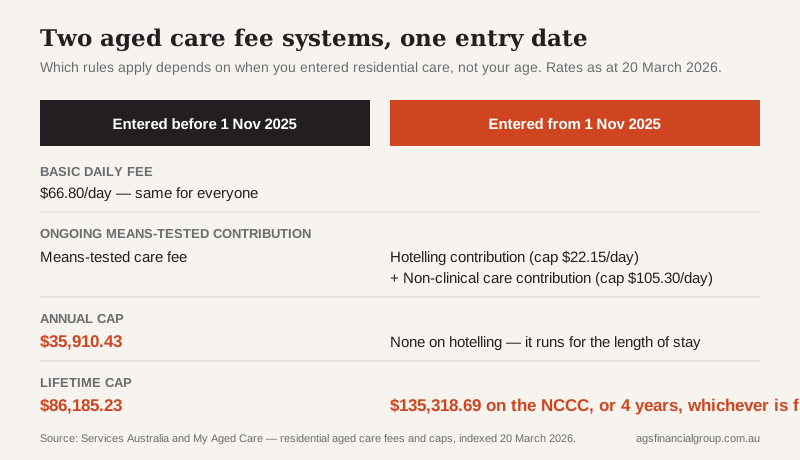
- Anyone who entered residential care before 1 November 2025 pays a means-tested care fee capped at $35,910.43 a year and $86,185.23 over a lifetime.
- Anyone entering from 1 November 2025 instead pays a hotelling contribution (capped at $22.15 a day, no annual or lifetime limit) plus a non-clinical care contribution capped at $135,318.69 over a lifetime, or four years, whichever comes first.
- The family home is only exempt from the aged care means test while a protected person (a spouse, a dependent child, or a qualifying carer or relative) still lives in it. Otherwise a capped value of up to $214,884 counts as an assessable asset.
- A Refundable Accommodation Deposit is assessable for aged care means testing even though it’s exempt from the Age Pension assets test.
Moving a parent, or yourself, into residential aged care means signing a resident agreement within days of a decision that took months to reach. The fee structure behind that agreement changed on 1 November 2025, and which rules apply depends entirely on the date someone enters care, not their age or how long they’ve been thinking about it. Getting the structure wrong, particularly around the family home, can cost thousands of dollars a year in fees that a different ownership or gifting decision would have avoided.
Two fee systems, one entry date
Everyone pays the same basic daily fee: $66.80 a day, set at 85% of the single Age Pension and indexed twice a year. What sits on top of that depends on when the resident moved in.
Residents who entered permanent residential care before 1 November 2025 stay on the old system: a means-tested care fee, assessed against income and assets, capped at $35,910.43 in any twelve-month period and $86,185.23 over a lifetime. Once either cap is reached, the fee drops to zero.
Residents entering from 1 November 2025 are on the Aged Care Act 2024 system instead. The means-tested care fee is replaced by two separate contributions: a hotelling contribution for everyday living costs like meals and laundry, and a non-clinical care contribution for personal care such as bathing, dressing and mobility support. Clinical care itself is now fully government-funded regardless of means.
The hotelling and non-clinical care contributions
The hotelling contribution is capped at $22.15 a day and keeps running for the entire length of stay. There’s no annual or lifetime limit on it, because the amount involved is small relative to the cost of care.
The non-clinical care contribution only applies once a resident is already paying the full hotelling contribution, and it’s capped at $105.30 a day. Unlike hotelling, it does have a ceiling: $135,318.69 in total, or four years of payments, whichever arrives first. After that, non-clinical care is provided at no further charge.
For a couple where one partner enters care under the new system, the daily contribution amounts can look higher than the old means-tested fee at the same asset level, but the newer system also fully funds clinical care from day one and puts a hard ceiling on the non-clinical component.
How the family home is assessed
The family home is the single biggest variable in most aged care fee calculations, and the rule that decides it is the protected person test.
If a spouse or partner keeps living in the home, it’s completely exempt from the aged care means assessment, for as long as they stay there. The same exemption applies if a dependent child lives there, or if a carer who has lived in the home for at least two years or a close relative who has lived there for at least five years is receiving an income support payment such as the Age Pension.
Without a protected person in place, the home isn’t ignored, but it isn’t counted at full value either. A capped amount, $214,884 as at March 2026 or the home’s actual net value if that’s lower, is added to assessable assets. That capped figure is what feeds into both the accommodation payment negotiation and the ongoing means-tested contribution, so it’s worth confirming before a resident agreement is signed rather than after.
The moment a protected person moves out or passes away, the exemption can end, and both the means-tested contribution and Age Pension entitlement can change from that point. Families sometimes discover this only when a carer who’d been living in the home moves into their own place a year or two later.
Accommodation costs: RAD and DAP
Beyond the daily fees, most residents also negotiate an accommodation payment, either a lump-sum Refundable Accommodation Deposit or an ongoing Daily Accommodation Payment, or a mix of both. The RAD is fully refunded when the resident leaves care or passes away, minus any amounts drawn down to cover fees along the way.
The RAD is exempt from the Age Pension assets test, which is one reason families sometimes assume it’s ignored everywhere. It isn’t. For the separate aged care means assessment, an unpaid RAD balance is counted as an assessable asset, and that can lift the ongoing daily contribution above what it would otherwise be. Whether to pay a full RAD, a partial RAD plus DAP, or all DAP is a cashflow and asset-structuring decision that benefits from being modelled against the specific fees involved, not decided on a rule of thumb.
Where advice earns its cost back
None of these numbers exist in isolation. The RAD-versus-DAP choice affects the means test. The means test affects the Age Pension. The Age Pension affects household cashflow for a spouse still living independently. A retirement planning adviser who can model all four together, alongside the estate planning consequences of how the family home is eventually dealt with, generally finds savings that outweigh the cost of the advice itself, particularly where a protected-person exemption or a RAD structuring choice is on the table.
The risk runs the other way too. A resident agreement signed under time pressure, without checking whether a protected person exemption applies or how a RAD will be assessed, can lock in a higher ongoing contribution for years. These decisions are difficult to unwind once a resident agreement is signed, so the right time to get advice is before entering care, not after the first invoice arrives.
Our aged care financial advice team works alongside families through this decision, coordinating the fee modelling, the Age Pension impact and the estate planning consequences in one conversation rather than three separate ones.
Frequently asked questions
Does the family home count towards aged care fees? Only if there’s no protected person living in it. With a protected person (a spouse, dependent child, or a qualifying carer or relative receiving income support), the home is fully exempt from the aged care means assessment. Without one, a capped value of up to $214,884 is included.
What’s the difference between the means-tested care fee and the new hotelling contribution? The means-tested care fee applied to everyone entering care before 1 November 2025 and is capped at $35,910.43 a year and $86,185.23 for life. From 1 November 2025, that fee is replaced by a hotelling contribution (capped at $22.15/day, uncapped in total) and a non-clinical care contribution (capped at $135,318.69 for life), with clinical care fully government-funded.
Is a Refundable Accommodation Deposit counted for the Age Pension? No, a RAD is exempt from the Age Pension assets test. It is still assessable for the separate aged care means test, so an unpaid RAD balance can raise the ongoing daily contribution even while it has no effect on pension entitlement.