
Key points
- The downsizer contribution lets eligible over-55s put up to $300,000 each ($600,000 per couple) from a home sale into super (ATO).
- It sits outside the normal concessional and non-concessional caps.
- You must have owned the home for at least 10 years and contribute within 90 days of settlement (ATO).
- Your home stays exempt from the Age Pension assets test, but freed-up cash is counted (and super once you reach 67 or start a pension), so downsizing can change your pension.
- The financial gain from downsizing is often smaller than expected once selling, buying and moving costs are counted.
The family home is usually the largest asset a retiree owns, and for many it’s worth more than their super. Selling it and moving somewhere smaller can release a big chunk of capital at exactly the point you need income. That’s the appeal. The reality is more mixed, and the decision turns on numbers that are easy to get wrong.
This is general information, not personal advice. Whether downsizing helps depends on your home’s value, your super balance, and whether you receive the Age Pension.
The downsizer contribution
The standout benefit is the downsizer contribution. If you’re 55 or older and sell a home you’ve owned for at least 10 years, you can put up to $300,000 each from the proceeds into super. A couple can contribute $600,000 between them. It sits outside the concessional and non-concessional caps, so it won’t use up your normal contribution room, and there’s no upper age limit or work test.
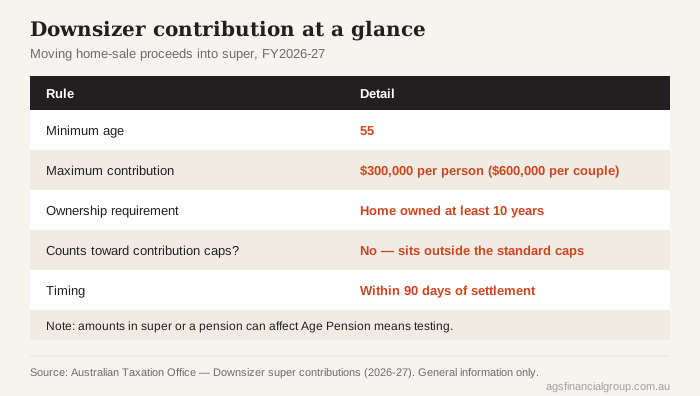
The timing rules are tight. The contribution has to be made within 90 days of settlement, and the property has to qualify for at least a partial main residence exemption. Miss the window and the money loses its special status, which can push it into your ordinary caps or lock it out entirely. Where the contribution lands matters too. Some couples direct it into a self-managed super fund they already run, which keeps the whole balance under one structure they control. Others simply add it to an existing fund. Either way, once it’s in super and you’ve met a condition of release, the earnings run in a low-tax or tax-free environment.
What downsizing really frees up
The capital released is the gap between what you sell for and what you spend on the next place, minus the costs of doing both. On a $1.6 million sale and an $1.1 million purchase, the headline gain is $500,000. That’s before agent commission, stamp duty on the new home, legal fees, and the cost of the move itself.
Those costs add up fast. Agent fees and marketing on the sale, stamp duty on the purchase, conveyancing on both, and removalists can take a meaningful slice out of the difference. On a downsize within the same city, it’s common for total transaction costs to run well into five figures. The gain is real, but it’s smaller than the price gap suggests.
Costs that eat into the gain
Before you commit, price the full round trip.
- Selling costs. Agent commission, marketing, styling and repairs to get the home to market.
- Buying costs. Stamp duty on the new property, which in most states is the single largest line, plus conveyancing and inspections.
- Moving costs. Removalists, new furniture that fits a smaller space, and the small renovations most people make to a new home.
- Emotional cost. Leaving a long-held home and community is a genuine factor, even though it doesn’t show up on a spreadsheet.
If the new home is only modestly cheaper than the old one, the transaction costs can swallow most of the benefit. Downsizing works best when there’s a clear gap between sale and purchase price, or when the move also cuts ongoing costs like rates, insurance and upkeep.
The Age Pension catch
Here’s where many people get caught. Your home is exempt from the Age Pension assets test, whatever it’s worth. Cash and shares are counted. Super is treated by age: it’s exempt while it sits in accumulation and the owner is under Age Pension age (67), and it’s counted once they reach 67 or move it into a pension account. When you sell an exempt asset and hold the proceeds as an assessable one, your assessable assets jump, and your pension can fall or stop.
Whose name the money is in matters too. Super held in accumulation by a spouse under 67 stays outside the assets test until they reach Age Pension age, so a couple with an age gap has more planning room than a single retiree already over 67.
A part-pensioner who sells a $1.6 million home, buys a $1.1 million unit and keeps $400,000 in super can find their pension cut. The Age Pension assets test is the number to model here, because the loss of pension income can offset a chunk of the return you earn on the freed-up capital. It doesn’t make downsizing a bad move. It means the after-pension outcome, not the headline gain, is the number that matters.
Is it right for you?
Downsizing makes the most sense when the home is genuinely too big or too costly to keep, when there’s a real price gap between it and a suitable smaller home, and when the released capital adds enough retirement income to justify the upheaval. It makes less sense when the numbers are close, when you’d lose more in pension than you’d gain in returns, or when you’re moving mainly because it feels like the expected thing to do.
The way to settle it is to model the whole picture as part of your retirement plan: the net proceeds after costs, the downsizer contribution, the change to your pension, and the income the money will generate. Our financial planning team runs that calculation before clients list the house, and if a smaller purchase needs finance, our mortgage brokers can bridge the timing between selling and buying. For a broader view of what a comfortable retirement costs, our guide on whether $2 million is enough to retire at 60 sets out the income side.
Frequently asked questions
How much can I contribute to super when I downsize? Up to $300,000 per person, or $600,000 for a couple, from the proceeds of selling a qualifying main residence. It sits outside the normal contribution caps, but you must be 55 or older, have owned the home for at least 10 years, and make the contribution within 90 days of settlement.
Does downsizing affect my Age Pension? It can. The home you live in is exempt from the Age Pension assets test whatever it is worth, and so is the smaller home you buy. What changes is the leftover money. Cash counts straight away. Super depends on age: it stays exempt while it is in accumulation and the owner is under Age Pension age (67), and it is counted once they turn 67 or start a pension account. Contributing to a younger spouse’s accumulation account can keep the money out of the test for longer, while a pension account, or super held by someone 67 or over, is assessed.
What age can I make a downsizer contribution? 55. The minimum age was lowered to 55 and there is no upper age limit, so it’s available well into retirement provided the other conditions are met.