Key points
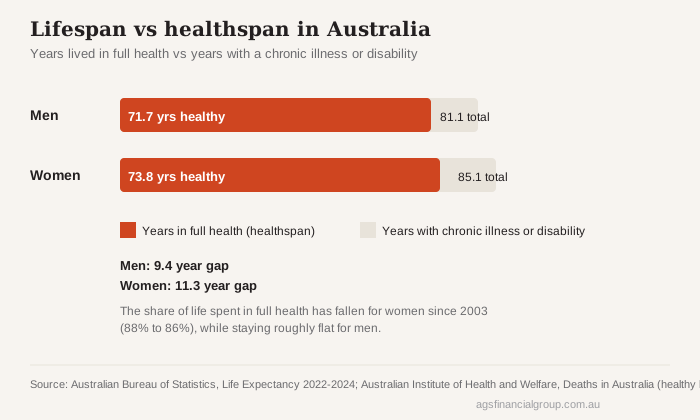
- Life expectancy at birth is 81.1 years for Australian men and 85.1 years for women (ABS, 2022–2024).
- Of those years, men spend 71.7 in full health and women 73.8, according to the AIHW’s healthy life expectancy estimates.
- That leaves an average gap of 9.4 years for men and 11.3 years for women spent with a chronic illness or disability.
- The share of life spent in full health has fallen for women since 2003, from 88% to 86%, while it has stayed roughly flat for men.
Most retirement plans are built around a single number: life expectancy. How much money you need to retire usually gets modelled against that one figure, whether the target balance is a few hundred thousand dollars or, for some higher-balance retirees, two million dollars or more. But life expectancy only tells you when a retirement ends. It says nothing about how much of it will be spent in good health, and that gap is where a lot of retirement plans come up short.
Lifespan and healthspan aren’t the same number
Healthspan is the portion of life spent free of significant chronic illness or disability. For the average Australian man, that’s 71.7 of his 81.1 years. For the average woman, 73.8 of 85.1. The difference, roughly nine years for men and eleven for women, isn’t a rounding error. It’s a decade or more where health costs typically rise, income from work is long gone, and the type of care needed changes.
And the average is only the midpoint. Some people reach 90 in excellent health. Others develop a chronic condition in their early 70s that changes their entire cost base. A retirement plan that only models to the average life expectancy, and only budgets for a healthy retiree’s costs, is planning for the middle and hoping nobody in the family lands at either end.
What the health gap costs a retirement plan
The financial shape of the healthy years and the unhealthy years is different, and treating them as the same phase is the most common gap we see.
Early retirement (the healthspan years). Spending tends to be higher here, not lower. Travel, hobbies, helping adult children, home renovations. This is the phase most retirement calculators are built around, and it’s the one clients instinctively plan for.
Later retirement (the health-gap years). Discretionary spending usually falls, but a different category of cost rises: home care, allied health, modifications to the home, and eventually residential aged care if it’s needed. These costs are lumpy rather than steady, and they can arrive with little warning after a fall, a diagnosis, or a stroke.
The years in between. A gradual decline in capacity often comes well before a full aged-care admission, and this stretch is the one families are least prepared for. It’s not dramatic enough to trigger a formal care plan, but it changes what a couple can manage themselves.
A plan that treats every year of retirement as a “normal” year, at a flat drawdown rate, tends to under-fund exactly the years where costs are least predictable.
Building healthspan into the plan
A few adjustments make a retirement plan more resilient to the healthspan gap, without requiring anyone to predict their own health outcome.
Model a health-cost reserve, not just a spending rate. Rather than assuming a flat withdrawal for 25 or 30 years, we build in a separate buffer sized for the later, higher-cost phase. It sits alongside the main portfolio rather than competing with day-to-day retirement spending.
Review insurance and aged-care funding together, not separately. Income protection and trauma cover matter before retirement. After it, the equivalent question becomes how home care or residential aged care would be funded, and whether the family home, super, or other assets are the right source for that.
Revisit the plan at the transition points, not just at retirement. The healthspan gap doesn’t announce itself. A plan reviewed only at age 65 and then left alone misses the point where a client’s actual health, not the average, starts to diverge from the model.
Keep estate and enduring documents current. Power of attorney and guardianship arrangements matter far more in the health-gap years than in the healthy ones, and they’re far easier to put in place before they’re needed than during a crisis.
The advice conversation this raises
None of this is about assuming the worst. Most of retirement is the healthspan years, and a good plan should fund an active, well-resourced version of them. But a plan that only accounts for the healthy average, and treats the later years as an afterthought, tends to leave families making decisions about aged care and home support under financial pressure at the worst possible time.
At AGS, retirement plans are built to cover both phases from the outset, with the aged-care and estate planning conversation happening well before it’s urgent. If your plan hasn’t been reviewed with the health-gap years in mind, book a conversation with one of our advisers.